Why Choose a Metal Cutting Board for Your Business?
Choosing a Metal Cutting Board for your business is a practical decision, not just a design choice. In a busy kitchen, prep surfaces face repeated chopping, rinsing, and contact with different ingredients. A board that cleans easily and holds up to daily use can help keep work moving. That matters.
Metal boards are often valued for their smooth, nonporous surfaces and sturdy construction. A quick wipe may remove visible residue, but proper washing and sanitizing still depend on the board’s design and your kitchen’s procedures. Look closely at the material, finish, edges, and manufacturer’s care instructions. Small details count. A rough seam or awkward corner can make cleaning more difficult.
There is a trade-off. Metal can feel firm and cool under a knife, and frequent cutting may affect blade sharpness or create more noise than softer board materials. The right choice depends on your menu, tools, staff habits, and cleaning routine. A board that suits a bakery may not be ideal for a high-volume meat station. No single surface fits every business.
This guide considers durability, hygiene, maintenance, cost, and everyday handling. It also asks a useful question: will the board work well after months of real service, not just on delivery day? Compare product specifications, check care guidance, and consider how your team will use it. A little hesitation is sensible. A metal board can be useful, but only when its strengths match the job.
What a Metal Cutting Board Is and How It Works
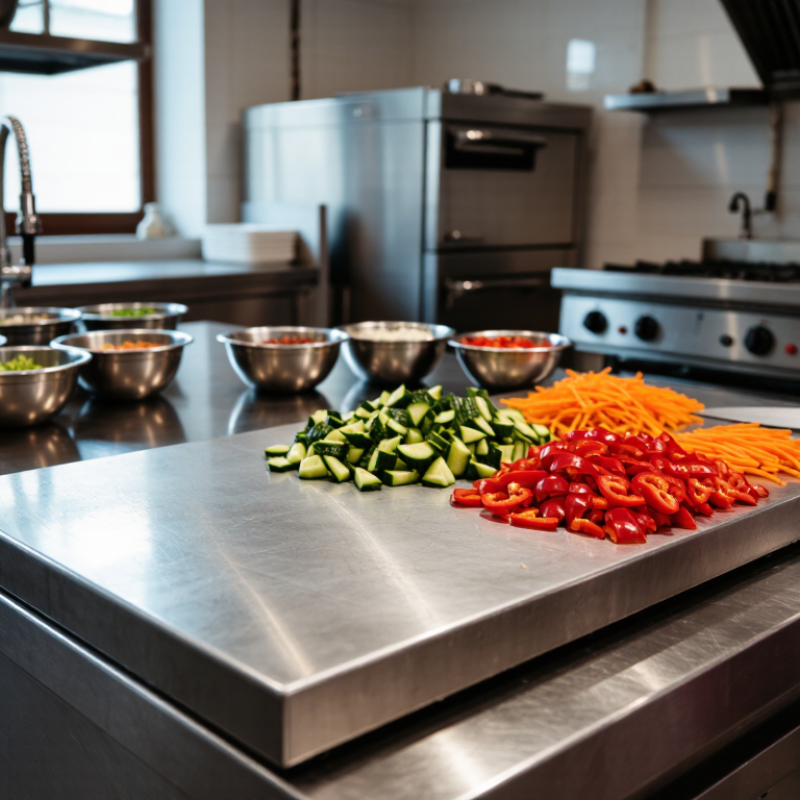
A metal cutting board is a flat prep surface made from food-contact metal, commonly stainless steel. Many designs use a solid plate or a metal top supported by a frame or core; edges may be raised or fitted with feet. Construction varies, so check product specifications rather than assuming every board is identical. The firm, nonporous surface does not absorb juices like unsealed wood. It can be washed readily, but seams, corners, and feet still need attention.
During use, the board provides a stable platform for portioning ingredients, trimming meat, or handling dough. Its weight and nonslip feet can help limit movement, though a wet underside or smooth counter may still cause sliding. Metal is hard, so repeated chopping may blunt knife edges faster than softer wood or plastic. The sound can also be sharp in a busy kitchen. Not ideal for every task. It can suit businesses that value quick cleanup and durability, but knife care and staff comfort matter too.
Tips: Place the board on a dry, level counter and test for movement before prep. Use a suitable sharp knife, avoid dragging the blade across the surface, and clean around joints after each shift. Inspect for dents or loose feet; small details are easy to miss during a rush.
Common Metals and Construction Features
Stainless steel is the most familiar choice for commercial metal prep boards. It resists rust and wipes clean, but the grade and finish matter. A smooth, food-contact-rated surface is easier to maintain than a rough or deeply scratched one. Aluminum weighs less and is easier to move between stations. However, it can dent, and some aluminum surfaces may react with acidic ingredients. Not every grade performs alike. Ask suppliers for material specifications rather than relying on appearance alone.
Construction details affect daily use. A thicker plate feels steadier under a cleaver, while a thin sheet may flex or drum against the counter. That small noise gets old. Look for rounded edges, secure seams, and a flat underside that will not rock on a worktable. Welds should be smooth and accessible for cleaning; trapped residue around a joint is a practical concern. Some metal surfaces are hard on knife edges, so test the board with the tools your staff actually use. A metal board may suit portioning or staging better than every cutting task. It is worth reconsidering the workflow before ordering several.
Business Benefits of Choosing a Metal Cutting Board
Why Choose a Metal Cutting Board for Your Business?
Businesses choose metal boards for durability, quick washdown, and easy visual inspection. A solid stainless-steel surface resists deep scoring better than many softer boards, helping staff spot residue. Choose food-contact-grade material with smooth welds and no exposed seams. Small details matter.
The FDA Food Code 2022 says food-contact surfaces should be smooth, durable, nonabsorbent, and easy to clean. It does not automatically endorse metal; design and upkeep still determine performance.
CDC’s 2011 estimates put foodborne illness at about 48 million cases annually in the United States, with 128,000 hospitalizations and 3,000 deaths. These figures do not compare cutting-board materials, but they show why sanitation deserves attention. A rinse alone is not a cleaning plan.
In high-volume kitchens, metal can tolerate frequent washing and resist absorbed moisture, potentially reducing replacement interruptions. But it can be noisy, slippery when wet, and tough on knife edges. That trade-off matters. Some kitchens may reserve metal for portioning or tasks where quick cleaning outweighs blade wear, while using softer boards for fine knife work.
Secure the board, follow approved cleaning and sanitizing procedures, and inspect its surface regularly. Metal helps; it does not replace good habits.
How to Select the Right Board for Your Operation
A metal cutting board can suit commercial kitchens that need a hard-wearing, nonporous work surface. The right choice depends on what your team cuts, how often the board is cleaned, and whether knives will contact it directly. Stainless steel resists rust and is straightforward to sanitize, but a hard surface can dull knife edges faster than wood or plastic. It can also be noisy. That trade-off is easy to overlook during purchasing.
Measure your busiest prep area before choosing a board. Leave enough room for ingredients, tools, and safe hand movement. Check the board’s thickness, edge finish, and weight; a board that shifts during chopping can create a real hazard. For wet work, look for secure feet or a stable mounting method. Confirm that the material is suitable for food contact and that the board fits your cleaning process. A board that cannot be cleaned conveniently may sit unused, even if it looks ideal on paper.
Tips: Match board size to your actual workflow, not just the available counter space. Ask staff to test a sample with their usual knives and cleaning routine. Inspect edges for burrs, and check for dents or deep scratches regularly. If knife wear becomes a concern, use the metal board for tasks that do not require direct blade contact. One detail may need revisiting after a week of use.
Why Choose a Metal Cutting Board for Your Business?
Compare representative thermal conductivity values to understand how quickly common board materials transfer heat.
Stainless steel transfers heat much faster than HDPE or maple, which can matter for temperature-sensitive workflows. These representative room-temperature values vary by grade, species, and conditions. Thermal conductivity alone does not determine suitability: metal can be hard on knife edges and slippery, so confirm food-contact suitability and assess the surface for your process.
Cleaning, Care, and Safe Use in the Workplace
In a busy kitchen, cleaning procedures must work during a real shift, not just on paper. Scrape away food scraps, then wash the board with warm water and detergent. Rinse it before applying a food-contact sanitizer, following the product’s stated dilution and contact time. A quick rinse is not enough. Keep boards or designated work areas separate for raw foods and ready-to-eat ingredients to reduce cross-contamination.
A smooth, undamaged metal board is usually straightforward to clean, but its care depends on its construction. Follow the maker’s instructions, especially if the board has seams, coatings, or removable parts. Wash and sanitize it between tasks, then dry it fully before storage. Keep it upright in a clean, ventilated rack. Dry it fully. Check the surface and edges regularly; dents, loose fittings, or rough spots can trap residue or create handling hazards.
For safe use, place the board on a stable, nonslip surface. If it shifts, stop and reset it rather than holding it in place while cutting. Metal can feel hard under a knife and may dull some blades faster than softer boards. That trade-off is easy to overlook during a rushed service. Train staff to use suitable knives, maintain them properly, and report damage instead of continuing to work on a board that feels unstable.
