Sorry, your browser is not supported. For a better experience, keep your browser up to date. Check here for latest versions
China’s stainless steel kitchen faucet industry includes manufacturers with different strengths, product ranges, and levels of export experience. This guide introduces notable suppliers and explains what buyers can examine before making contact. A polished catalogue is useful, but it does not prove consistent production quality.
A Stainless Steel Kitchen Faucet should be assessed beyond its finish and price. Check the stated steel grade, surface treatment, cartridge specifications, hose construction, and available product testing documents. Ask how the supplier handles inspection, packaging, spare parts, and custom orders. Details matter. A sample can also reveal practical issues, such as a stiff handle, uneven spray, or a pull-down hose that retracts poorly.
No single manufacturer suits every project. Some buyers prioritize design flexibility; others need stable lead times, clear documentation, or support after delivery. Product claims and certifications should be verified for the specific model, not assumed from a company profile. This comparison is a starting point, not a substitute for due diligence. Even a carefully prepared shortlist can miss differences that only become clear after samples and direct questions. That is worth remembering.
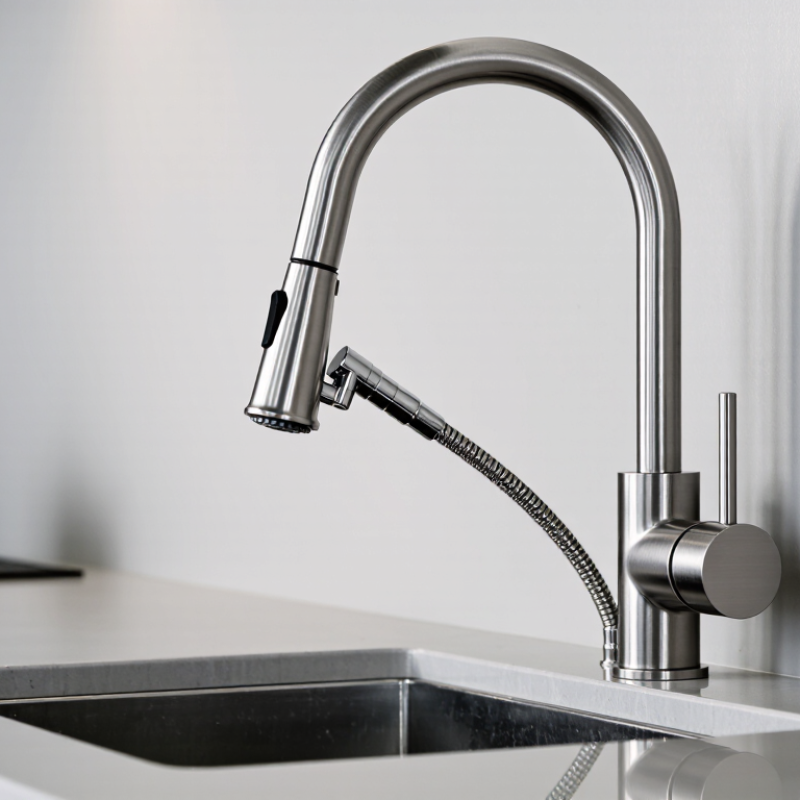
A stainless steel kitchen faucet is defined by its material, construction, and performance—not simply by a silver-colored finish. The main body may use stainless steel, while internal cartridges, seals, and connectors can use other materials. Check product specifications to see which parts are actually stainless. The grade matters, too. Grade 304 is widely used for kitchen fixtures because it offers useful corrosion resistance in everyday conditions. Grade 316 contains molybdenum and can better withstand certain corrosive environments, though it may not be necessary for every home. More metal is not automatically better.
Construction affects daily use. A well-made faucet should feel stable at the sink, turn smoothly, and avoid drips around the handle or base. Look for clear details about the steel grade, wall thickness, cartridge type, and tested operating cycles. These specifics are more useful than a vague “stainless steel” label. Finish also matters: brushed surfaces can hide fingerprints better than polished ones, but neither finish is maintenance-free. Wipe away water spots with a soft cloth. Avoid harsh cleaners. Even quality steel can stain under the wrong conditions, and that is easy to overlook. A faucet’s real value becomes clearer after months of use, not just under showroom lights.
China’s stainless steel kitchen faucet industry is not one uniform factory network. It is a layered system. Some manufacturers cast or machine faucet bodies, while others focus on cartridge assembly, surface finishing, or complete product production. In manufacturing clusters, nearby suppliers provide tubing, valves, handles, hoses, and packaging. This proximity can shorten development cycles, though it does not guarantee consistent quality.
Larger factories may manage design, tooling, assembly, and export documentation under one roof. Smaller workshops often specialize in polishing, machining, or custom orders. Buyers should clarify who controls each production stage. A polished sample may look excellent, yet hidden details matter: wall thickness, weld quality, cartridge fit, and leak-test records. Judge factory capability through process evidence, not catalog photos alone. Some suppliers call themselves manufacturers when production is partly outsourced. That distinction can be easy to miss.
Tips: Request a component list, material specification, and recent inspection records. Ask how each faucet is tested, and confirm that the sample matches the planned production batch. Allow time for a pre-shipment check. Small differences in finish or handle movement can become costly at scale.
A sound manufacturer review begins with materials, test evidence, and repeatability—not a polished showroom sample. Ask for the brass or stainless-steel grade, cartridge specifications, and independent test records. For drinking-water contact, check whether products meet relevant NSF/ANSI/CAN 61 and NSF/ANSI 372 requirements. Certification scope matters; a factory’s general quality certificate does not prove every faucet model was tested. The U.S. Environmental Protection Agency estimates household leaks waste nearly one trillion gallons of water each year. That figure covers many leak types, not faucets alone, but it shows why shutoff performance deserves careful testing. Small details count.
Evaluate how the factory controls production between sample approval and bulk shipment. Request pressure, leak, finish-adhesion, and cycle-test methods, plus recent pass rates and corrective-action records. Verify that the tested model matches the quoted model. Ask how batches are traced and what replacement parts remain available. A useful audit also checks calibration logs and staff training, not just clean floors. I would compare warranty terms with actual service procedures; generous wording can hide slow parts support. No single metric settles the choice. Some suppliers may resist sharing factory-level data, and that should prompt further questions, not an automatic rejection.
China’s stainless steel faucet industry includes manufacturers with different strengths. Some focus on high-volume production, while others handle smaller custom orders. Their capabilities can vary in material sourcing, machining, polishing, and quality inspection. A polished sample is useful, but it does not prove that every production batch will match it.
When comparing supplier profiles, ask what stainless steel grade is used and how material claims are verified. Request details about cartridge sourcing, leak testing, surface finishing, and inspection records. A capable manufacturer should explain its process clearly and provide consistent product specifications. Factory visits or independent inspections can offer added confidence, though neither replaces ongoing quality checks. Communication matters, too. Small differences in thread dimensions or installation requirements can cause delays after delivery.
Tips: Request a production sample and check its weight, finish, handle movement, and connections. Ask how defects are recorded and resolved. Keep written specifications for each order. One useful question: “Can you show batch inspection records?” Not every supplier will answer perfectly; unclear answers deserve follow-up. A low quoted price may also reflect different materials or service levels, so compare like for like.
When comparing China-based stainless steel kitchen faucet suppliers, look beyond polished samples. Check whether they control casting, CNC machining, polishing, assembly, and final testing in-house. The World Stainless Association reported global stainless-steel melt-shop production of 58.4 million tonnes in 2023, up 4.6% from 2022. This shows the scale of the material supply chain, not the quality of any single faucet. Ask suppliers to identify steel grades and provide traceable material records.
Review certifications by scope. NSF/ANSI/CAN 61 addresses health effects of drinking-water system components, while NSF/ANSI 372 covers lead-content requirements. Verify that certificates and test reports name the exact product or material, not just the factory. ISO 9001 indicates a quality-management system; it does not certify faucet performance. Request recent pressure, leak, flow, and cartridge-cycle test results, plus calibration records for testing equipment.
Tips: Ask for a production-line video and a sample batch inspection report. Compare the reported defect rate with your own acceptance criteria. A showroom sample can look excellent while batch consistency remains uncertain; I would want to check that point twice. Short audit visits may also miss seasonal workload changes.
Suggested weighting for comparing suppliers. These are evaluation weights, not measured market data or ratings of specific manufacturers.
Check certifications against the destination market and exact faucet model. Relevant references may include ISO 9001 for quality management, NSF/ANSI/CAN 61 for drinking-water system components, NSF/ANSI 372 for lead-content requirements, and ASME A112.18.1/CSA B125.1 for plumbing supply fittings. Also verify production capacity, inspection records, customization capability, and delivery performance with supporting documentation.