Sorry, your browser is not supported. For a better experience, keep your browser up to date. Check here for latest versions
Biomass Leather is an umbrella term, not a guarantee of one recipe or performance level. Products may use agricultural residues, plant fibers, or other biological feedstocks, combined with binders, coatings, and textile backings. The details matter. A material’s advertised biomass content alone cannot show how it performs, how long it lasts, or what happens at disposal.
Circular-design expert William McDonough is associated with the phrase, “Waste equals food.” It offers a useful lens for evaluating biomass-based materials, but it is not proof that every product turns waste into a fully circular solution. Buyers should ask manufacturers for clear feedstock information, the percentage of biomass, and details about synthetic components. Request sample swatches, abrasion and flex-test results, production capacity, minimum order quantities, lead times, and batch-level traceability. Confirm claims with documentation where available.
This Top 10 guide is intended to help global buyers compare manufacturers with practical questions, not simply attractive product names. Some suppliers may provide stronger evidence than others, and their capabilities can change. A polished sample is not the same as consistent production at scale. Nor does a plant-based input automatically mean low impact or easy end-of-life processing. Those gaps deserve attention. Use the shortlist as a starting point, then assess each supplier against your product’s real requirements, from upholstery wear to color consistency and delivery reliability.
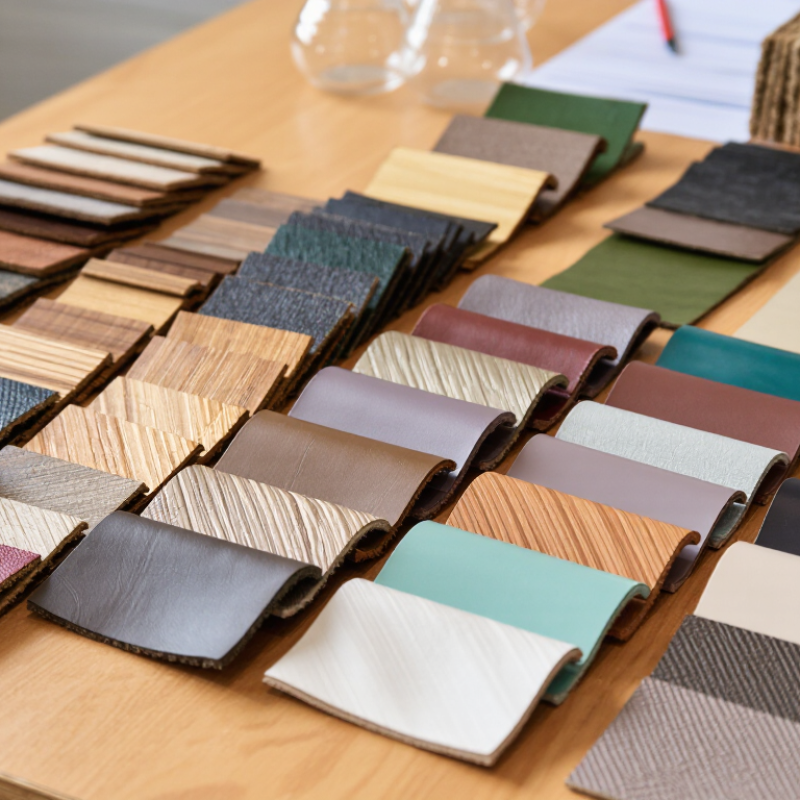
Biomass leather is a leather-like sheet made partly from biological materials, such as plant residues, fungal mycelium, or bacterial cellulose. It is not one standardized recipe. Some products use fibers or powders from biomass; others grow a dense network of mycelium into a flexible sheet. Manufacturers may combine these materials with binders, textile backing, and surface coatings to improve strength, feel, and water resistance. The final material can therefore contain both bio-based and fossil-based components.
Production varies by feedstock. Plant residues are cleaned, dried, and processed into fibers or particles, then blended with a binder and pressed or coated onto a backing. Mycelium is grown under controlled conditions, harvested, and shaped before finishing.
Moisture, crop seasons, and inconsistent residue quality complicate sourcing. And “bio-based” does not automatically mean biodegradable: coatings, adhesives, and backing can change a product’s end-of-life options. Buyers should ask manufacturers for material composition, test results, and feedstock traceability. The details matter.
Evaluating biomass leather manufacturers starts with the recipe, not the marketing claim. Ask what share comes from agricultural residues, fungi, or other biomass, and what share comes from fossil-based binders and coatings. Request batch-level feedstock records and independent tests for abrasion, flexing, colorfastness, and hydrolysis. Ask for the test. A plant-based surface can still rely heavily on synthetic layers.
Compare environmental claims using a life-cycle assessment with a clear functional unit, such as one square meter of finished material. Check whether it includes farming, processing, coating, transport, and end-of-life assumptions. The FAO’s 2013 report estimated livestock supply chains produced 14.5% of human-caused greenhouse gas emissions; this is sector-wide context, not a leather-specific footprint. Textile Exchange’s Materials Market Report 2024 estimated global fiber production at 124 million tonnes in 2023, showing the scale of material supply chains, but fiber figures are not directly comparable to leather alternatives. Numbers need context. Prefer assessments aligned with ISO 14040/14044 and verified by an independent reviewer. Also inspect pilot-to-commercial production consistency: a sample swatch may feel supple, while a full roll can vary in thickness, odor, or finish. No supplier is perfect; document gaps and ask how they will be measured.
Buyer evaluation framework—not a company ranking. Biomass-based materials vary in composition, performance, and environmental attributes; verify each claim against product-specific documentation.
| No. | Evaluation dimension | What to assess | Evidence to request |
|---|---|---|---|
| 1 | Biomass feedstock | Identify the biological input—such as agricultural residues, fruit-processing by-products, cork, or mycelium—and whether it is a primary ingredient or a minor additive. | Feedstock description, origin, chain-of-custody records, and the percentage used in the finished material. |
| 2 | Material composition | Check the full construction, including the surface coating, binder, backing fabric, and any fossil-based or other non-biomass components. | Technical data sheet stating component materials and the calculation basis for any bio-based-content claim. |
| 3 | Bio-based-content verification | Distinguish bio-based carbon content from the total weight percentage of biomass. These are different measurements and should not be presented as interchangeable. | Test report or certification with scope, tested product, method, and date. ASTM D6866 and EN 16640 are methods for determining bio-based carbon content. |
| 4 | Performance and durability | Match performance to the intended use, such as upholstery, footwear, bags, or apparel. Relevant properties may include abrasion, flexing, tear strength, and colorfastness. | Product-specific test reports using agreed methods, sample conditioning, test criteria, and acceptance limits. |
| 5 | Chemical management | Review chemical controls for coatings, adhesives, dyes, and finishing agents, with requirements tailored to the destination market and end use. | Current restricted-substances declarations and relevant independent test reports. Check the scope and validity of any claimed certification. |
| 6 | Environmental claims and LCA | Compare claims only when the functional unit, system boundary, geography, and assumptions are clear. A biomass input alone does not establish a lower environmental impact. | Product-level life-cycle assessment or carbon-footprint study; ISO 14040/14044 address LCA principles and framework, and ISO 14067 addresses product carbon footprints. |
| 7 | Production capacity and consistency | Confirm available production volume, lead times, quality controls, and the supplier’s ability to maintain color, thickness, and performance across batches. | Capacity statement, production schedule, quality-control plan, and records from representative production batches. |
| 8 | Traceability and sourcing | Establish where biomass is sourced and processed, and how its identity is maintained through the supply chain. | Supplier declarations, sourcing records, traceability procedures, and audit documentation where applicable. |
| 9 | End-of-life and recyclability | Ask how the complete material can be handled at end of life. Composite layers and coatings may affect separation, recycling, or biodegradation. | Product-specific disposal or recycling guidance and test evidence supporting any biodegradability or compostability claim. |
| 10 | Commercial and export readiness | Evaluate minimum order quantities, sampling, customization, packaging, shipping terms, and documentation needed for the buyer’s destination market. | Written quotation, sample policy, specification sheet, lead-time estimate, and applicable export and compliance documents. |
Global buyers comparing the top 10 biomass leather manufacturers should look beyond polished samples. Feedstock consistency, coating chemistry, backing fabric, and production capacity all affect the finished material. A swatch may feel supple in a showroom, yet crack after repeated bending or absorb moisture at the edges. Test it.
The scale of material demand makes careful sourcing important. Textile Exchange’s 2024 Materials Market Report says global fiber production reached 124 million tonnes in 2023 and could rise to 160 million tonnes by 2030. UNEP’s Food Waste Index Report 2024 estimates that 1.05 billion tonnes of food were wasted in 2022; only a fraction is suitable for material production. Buyers should ask manufacturers to document feedstock origin, bio-based content, durability tests, and end-of-life limits. Requesting the same test conditions across suppliers makes comparisons more useful. A ranking can still mislead: “biomass-based” does not automatically mean fully biodegradable or lower-impact. Some products use mixed polymers, and public lifecycle data can be incomplete. That gap deserves scrutiny. Ask for traceable evidence, not just attractive claims.
Material comparisons should start with the bill of materials, not the word “biomass.” Ask suppliers to disclose feedstock, bio-based carbon share, backing fabric, binders, and surface coatings. ASTM D6866 or ISO 16620-2 testing can substantiate bio-based carbon claims; it does not prove biodegradability. Request abrasion, hydrolysis, flex, and colorfastness results for your intended use. Inspect the same finish after wet rubbing and repeated folding. Small samples mislead.
Textile Exchange’s Materials Market Report 2024 estimates global fiber production reached 124 million tonnes in 2023. This is not a leather-alternative market estimate, but it shows the scale of material competition. Compare environmental data only when boundaries, functional units, and end-of-life assumptions match. Where relevant, verify ISO 14001 and ISO 9001 certificates, including site, scope, and expiry date. Paper is not proof.
Capacity checks need evidence from the actual production line: monthly saleable output, first-pass yield, lead times, and batch variation. Ask for results from three recent lots, not just a polished swatch. Confirm coating width, minimum order quantity, backup feedstock, and corrective-action records. Pilot a production-sized order before committing. Formulations can shift between harvests, so record acceptable tolerances.
International buyers should treat “biomass leather” as a material description, not proof of low impact. Ask suppliers to disclose the biomass percentage by weight, the source of each feedstock, and the coatings, backing, and binders used. Ask for batch records. Textile Exchange’s Materials Market Report 2024 puts global fibre production at 124 million tonnes in 2023, showing the scale of material sourcing behind textile supply chains. That figure does not measure leather alternatives, but it reinforces why clear composition data matters.
Request test results for abrasion, flexing, hydrolysis, colourfastness, and restricted-substance screening. Match the test method to the product: a shoe upper faces different stress from a decorative panel. Confirm that samples and production batches use the same formulation. They may not. Check minimum order quantities, lead times, production capacity, and whether the supplier can provide consistent colour across repeat shipments.
Environmental claims need boundaries. UNEP’s 2023 textile value-chain roadmap cites estimates that textiles contribute roughly 2–8% of global greenhouse-gas emissions; this broad range is not a product-level footprint. Ask for a life-cycle assessment that states its functional unit, system boundaries, and data sources. Also verify whether agricultural residues are genuinely waste materials or have competing uses. A bio-based share alone cannot settle that question.