Top 10 Steel Mill Equipment Manufacturers Worldwide
Steel mills depend on more than furnaces and rolling stands. They rely on coordinated systems that move, heat, shape, cool, and inspect steel under demanding conditions. A dependable equipment choice can affect product consistency, energy use, maintenance time, and worker safety. Small details matter: the alignment of a roller, the response of a temperature sensor, or the availability of a replacement drive. Not always neatly.
This guide to the Top 10 Steel Mill Equipment Manufacturers Worldwide examines suppliers through practical considerations, including equipment range, automation, engineering support, service reach, and lifecycle needs. The list is a comparison, not a universal verdict; a plant’s output, product mix, and existing infrastructure can change what “best” means. Steelmaking pioneer Sir Henry Bessemer wrote, “I had no fixed ideas derived from long-established practice to hamper me.” His words suit an industry that keeps improving its processes, though new technology is not automatically the right answer. That is the catch. Buyers should assess proven performance, integration requirements, spare-parts access, and the quality of commissioning support—not just headline capacity. This overview offers a starting point for that assessment and highlights manufacturers serving different parts of the production chain. It cannot replace plant-specific engineering review. A shortlist should be tested against real operating conditions, including downtime constraints and future expansion plans.
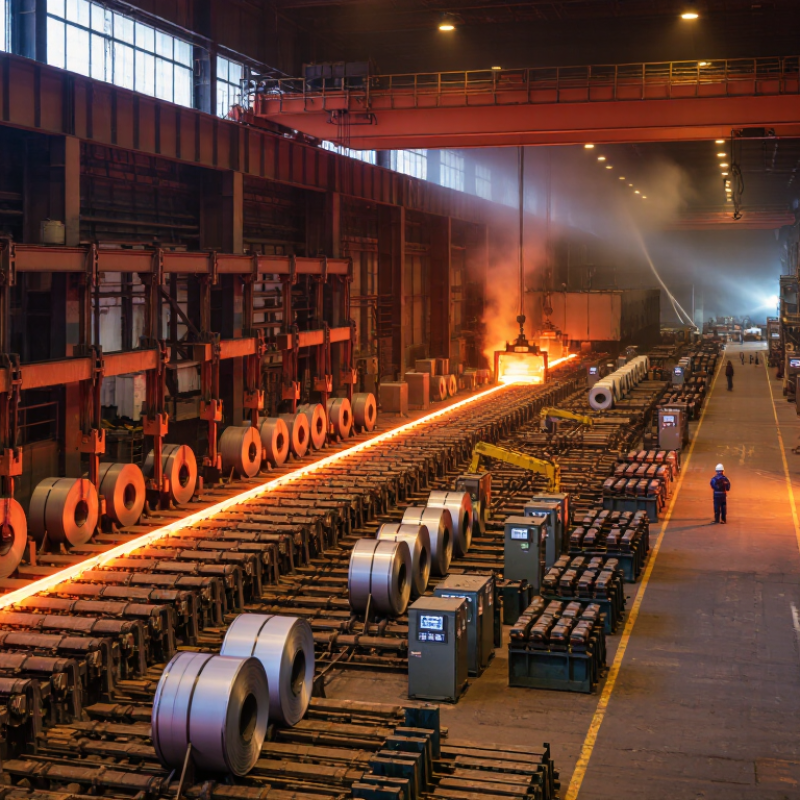
Steel Mill Equipment and Its Role in Modern Steel Production
Modern steel production depends on coordinated equipment, not a single furnace. In an integrated mill, coke ovens, blast furnaces, converters, and casting machines move material through distinct stages. An electric-arc-furnace plant follows a different route, melting scrap or direct-reduced iron with electrical energy. Both approaches rely on material handling systems, sensors, powerful drives, and process controls. Small delays spread quickly.
At the furnace, refractory-lined vessels contain intense heat. Oxygen lances or electrodes support melting and refining, while ladle systems carry liquid steel to secondary metallurgy. There, operators adjust temperature and composition to meet product requirements. Continuous casters form molten steel into slabs, blooms, or billets. Rollers and cooling sprays help control solidification and shape. Scale, vibration, and heat challenge motors, bearings, and alignment. Maintenance details matter.
Rolling mills reduce cast sections into plate, coil, bar, or structural shapes. Their stands, rolls, hydraulic systems, and cooling circuits influence dimensions and surface quality. Sensors can flag temperature shifts or unusual vibration, but readings still need calibration and skilled interpretation. Automation helps; it does not remove judgment. A clean dashboard cannot reveal every worn guide or blocked nozzle. One blind spot is assuming equipment performs as designed just because production targets are being met.
Top 10 Steel Mill Equipment Manufacturers Worldwide - Steel Mill Equipment and Its Role in Modern Steel Production
Representative equipment categories and their roles in steel production. Entries are not a company ranking and do not identify manufacturers or brands.
| No. | Equipment Category | Production Stage | Primary Role | Typical Output or Result |
| 1 | Blast Furnace Systems | Ironmaking | Reduce iron-bearing burden with carbon monoxide and heat to produce molten iron. | Hot metal, commonly called pig iron |
| 2 | Basic Oxygen Furnaces (BOF) | Steelmaking | Refine hot metal by blowing oxygen into the converter; scrap is also used as a coolant and charge material. | Liquid steel |
| 3 | Electric Arc Furnaces (EAF) | Steelmaking | Melt metallic charge, often scrap or direct-reduced iron, using electric arcs. | Liquid steel for casting |
| 4 | Secondary Metallurgy Equipment | Ladle refining | Adjust temperature and chemistry, remove impurities, and support processes such as vacuum treatment. | Steel with controlled composition and cleanliness |
| 5 | Continuous Casting Machines | Casting | Solidify liquid steel continuously in a water-cooled mold and guide the strand through cooling and withdrawal. | Slabs, blooms, or billets |
| 6 | Reheating Furnaces | Before hot rolling | Heat semi-finished steel to a suitable, reasonably uniform temperature for plastic deformation. | Hot slabs, blooms, or billets ready for rolling |
| 7 | Hot Rolling Mills | Hot forming | Reduce steel thickness or shape it at elevated temperatures using rolls. | Hot-rolled strip, plate, sections, or bars |
| 8 | Cold Rolling Mills | Finishing and dimensional control | Reduce strip thickness at or near room temperature to improve dimensional accuracy and surface finish. | Cold-rolled strip and sheet |
| 9 | Steel Heat-Treatment Furnaces | Thermal processing | Apply controlled heating and cooling cycles to modify properties such as hardness, strength, and ductility. | Heat-treated steel products |
| 10 | Inspection and Process-Control Systems | Across production stages | Monitor process variables and detect surface or dimensional defects using sensors and inspection equipment. | Measured process data and quality-inspected products |
Criteria for Comparing Global Equipment Manufacturers
Comparing global steel mill equipment manufacturers requires more than matching rated capacity. The International Energy Agency’s Iron and Steel Technology Roadmap (2020) estimates that steelmaking accounts for about 7% of global energy-system emissions. That makes energy use per tonne a practical comparison point, alongside output, yield, and product quality. Ask suppliers for measured results from similar furnaces or rolling lines, not only design targets. Small differences matter.
World Steel Association’s World Steel in Figures 2024 puts 2023 crude steel production at roughly 1.9 billion tonnes. At this scale, even short unplanned stops can disrupt schedules and raise costs. Compare documented availability, maintenance intervals, spare-parts lead times, and commissioning support. Check whether controls can integrate with existing systems, and request references from plants with similar products and operating conditions. A polished proposal cannot prove performance.
Lifecycle cost deserves equal weight. Compare energy and consumables, installation requirements, operator training, upgrade options, and expected maintenance over the equipment’s service life. Ask how performance claims were measured and what assumptions were used. No scorecard is perfect. I would still question any offer that promises high uptime without explaining how outages, parts, and local service are handled.
Regional Distribution of Leading Steel Mill Suppliers
Steel mill equipment suppliers are concentrated in regions with established steel industries, engineering expertise, and dense industrial supply chains. East Asia has a broad base of manufacturers serving integrated mills and smaller producers. Its proximity to steel plants, ports, and component makers can shorten delivery routes. That matters.
Europe remains an important center for specialized process equipment, automation, and environmental systems. Suppliers there often work across borders, adapting designs to different plant layouts and operating needs. North America has a strong market for modernization, maintenance, and upgrades, where older facilities may need new controls or more efficient production lines. India is also expanding its industrial capacity, supporting demand for equipment suited to both new projects and existing mills.
Regional presence does not always mean local manufacturing. A supplier may design equipment in one country, source components elsewhere, and rely on local contractors for installation. A map can look tidy, but it misses these connections. Buyers should compare service coverage, spare-part access, and commissioning experience, not just the supplier’s headquarters. Even then, regional labels can mislead: two nearby mills may have very different technical needs. A careful comparison starts with the plant, not the map.
Top 10 Steel Mill Equipment Manufacturers Worldwide — Regional Distribution
Regional steel-production footprint of the world’s top 10 steel-producing economies, 2023
Asia accounts for the largest share of output among these ten economies, indicating where steelmaking capacity—and potential demand for mill equipment—is concentrated. Regional totals group China, India, Japan, South Korea, and Iran in Asia; Russia, Germany, and Türkiye in Europe; the United States in North America; and Brazil in South America. This is a production-based market context, not a count of equipment manufacturers or their headquarters.
Source: World Steel Association, 2023 crude steel production figures. Values are rounded and shown in million tonnes.
Profiles of Ten Major Steel Mill Equipment Manufacturers
Steel mill equipment manufacturers often specialize in different stages of production. A useful profile looks beyond machine size to service access, operating conditions, and integration needs. One group designs complete production lines, coordinating furnaces, casters, and rolling equipment. Another focuses on reheating furnaces, where burner control and temperature uniformity affect billet quality. A third builds continuous casting systems, with mold cooling and strand guidance central to reliable operation.
Rolling equipment makers supply stands, drives, and roll-changing systems. Their designs must handle heavy loads while allowing practical maintenance. Automation specialists connect sensors, motor controls, and production software. Good control rooms make alarms clear, not merely numerous. Material-handling manufacturers build cranes and conveyors for hot, dusty mill environments. Environmental equipment suppliers focus on dust collection, water treatment, and heat recovery.
Other manufacturers concentrate on finishing lines, including cutting, straightening, and surface inspection equipment. Retrofit specialists adapt older mills, though fitting modern controls into legacy layouts can be awkward. Testing and measurement providers supply gauges that track dimensions and process variation. Their readings are useful only when calibration and operator training receive equal attention.
Details matter.
Comparing these ten manufacturer profiles means checking reference installations, spare-parts availability, commissioning support, and documented performance limits. A polished specification can still leave unanswered questions about downtime or access to critical components. Ask how equipment behaves during a product change, not only at steady production.
Real operating conditions are rarely tidy.
Key Technologies Shaping the Industry’s Future
Steelmaking’s next gains may come from better coordination, not a single breakthrough machine. Digital twins can link furnace conditions, rolling schedules, and energy use in one working model. Yet a model is only as reliable as its measurements. Sensors near hot, dusty equipment can drift, and small errors matter.
Predictive maintenance uses vibration and temperature data to flag wear before a motor or roll fails. Useful, but not infallible. Operators still need to check the bearing, the sound, and the production context. Artificial intelligence can also adjust process settings in real time, though unclear recommendations may slow a shift rather than help it. Clear displays matter.
Electrified heating, hydrogen-based ironmaking, and improved heat recovery could reduce reliance on fossil fuels, depending on power supply, raw materials, and plant design. Retrofitting an older mill is rarely simple. Space is tight. Robotics can handle repetitive inspection in hot or noisy areas, while workers focus on exceptions and safe maintenance. Connected systems also raise cybersecurity and training needs. A mill can own advanced software and still struggle if teams lack time to use it well. That gap deserves more attention.
