Sorry, your browser is not supported. For a better experience, keep your browser up to date. Check here for latest versions
Choosing a 3d Wall Panel is about more than picking an attractive pattern. Buyers also need to consider room size, surface material, installation, and everyday care. A raised geometric design may add depth behind a sofa, while a softer linear pattern can suit a quiet bedroom. The right choice depends on the space. And on your taste.
This guide explores ten designs and the practical questions worth asking before you buy. You’ll find ideas ranging from clean, repeating forms to sculpted textures that catch light across a feature wall. Look closely at panel dimensions, edge details, finish, and the wall’s condition. Ask how samples appear under your own lighting; a showroom image can be misleading. Small details matter. So does installation access, especially around outlets, corners, and trim. Product specifications and supplier guidance are useful starting points, but they do not replace checking measurements at home. Some choices may look striking online and feel too busy in person. That is worth admitting. The overview is intended to help buyers compare options, not promise that one design fits every room. Use it to narrow the field, then confirm materials, care requirements, and fitting instructions before making a final decision.
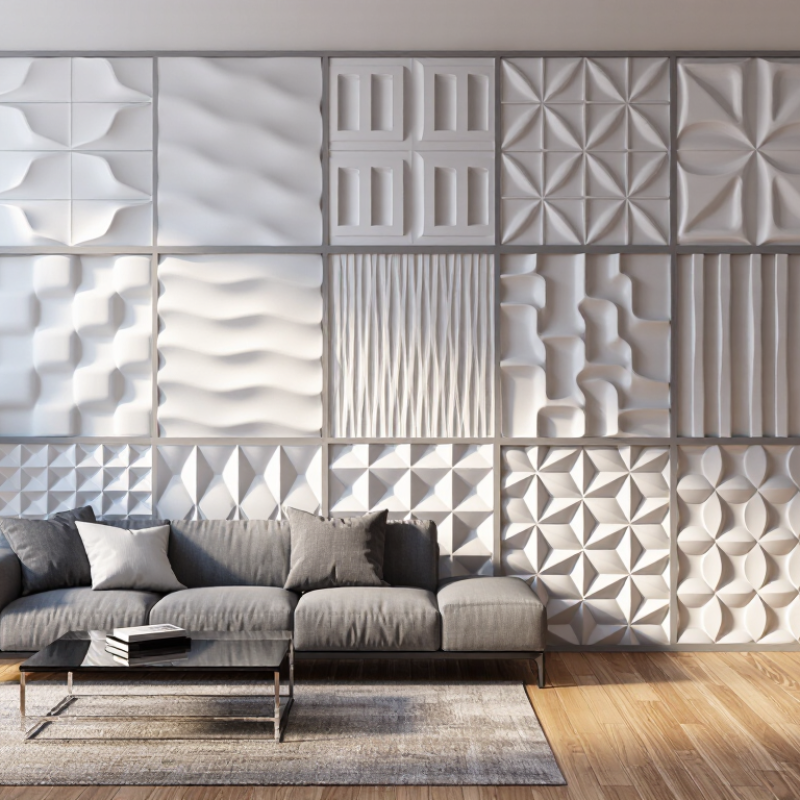
3D wall panels are best compared through three practical categories: material, profile, and installation. Common materials include moisture-resistant PVC, paintable MDF, gypsum, and natural wood. Each behaves differently. PVC wipes clean, while MDF can be easier to paint but needs protection from damp areas. Gypsum creates crisp relief, though it may chip during handling. Buyers often explore ten familiar looks, including fluted, wave, geometric, honeycomb, and brick-inspired designs. The right choice depends on the room, not just a product photo.
Profile describes the panel’s raised shape and shadow. Shallow ridges suit narrow hallways; deeper geometric forms can make a broad feature wall feel more dimensional. Check samples under the room’s actual lighting. A pattern that looks subtle in a showroom may cast strong shadows at home.
Installation also matters: panels may use adhesive, screws, or a batten frame. Uneven walls can make direct installation frustrating. I have seen small gaps become surprisingly noticeable.
Tips: Measure the wall in several places, and confirm panel thickness before ordering. Ask how edges and corners are finished. Leave the specified expansion gap, especially with wood-based panels. And keep one spare panel. Mistakes happen.
Vertical fluted panels add height to narrow entryways and suit calm, modern interiors. Their grooves collect dust, though, so consider cleaning before covering a busy hallway. Geometric relief panels bring sharper shadows to living rooms; choose shallow patterns if furniture sits close. Wave designs soften bedrooms or reading corners, especially under warm side lighting. Keep the finish matte. Gloss can make every ripple feel louder.
Brick-effect panels offer an industrial look for dining spaces, while botanical reliefs bring gentle detail to a bedroom or sunroom. Fabric-textured panels can warm a home office, but check cleaning instructions before choosing them. Hexagonal designs work well as a focused feature behind a desk or bed. Too many cells may feel restless. Timber-look slat panels suit Scandinavian and contemporary rooms, and can help break up a long wall without dominating it.
Stone-effect panels give fireplaces or broad living-room walls a grounded feel, but heavy-looking patterns may overwhelm compact spaces. Abstract sculptural panels suit buyers seeking a statement feature; test a sample against the room’s actual lighting first. Low-profile linear panels are a quieter choice for rentals or flexible rooms, where easy removal matters. Measure carefully, and check panel weight and installation requirements. A design can look perfect online and still feel wrong at home.
| Panel Design | Visual Effect | Rooms to Consider | Style Match | Common Materials | Buyer Considerations |
|---|---|---|---|---|---|
| Geometric Blocks | Raised squares, rectangles, or angled forms create strong shadows and a structured feature wall. | Living rooms, entryways, home offices | Contemporary, minimalist, industrial | MDF, gypsum, PVC, polyurethane | Works well as a focal point. Check the panel depth and layout before ordering, since strong patterns can feel busy across a large wall. |
| Wave or Ripple | Curved, repeating lines give the wall a flowing appearance and change subtly with the light. | Bedrooms, living rooms, reception areas | Modern, soft contemporary, spa-inspired | Gypsum, MDF, PVC, polyurethane | Consider lighting direction: side lighting can emphasize the contours. Confirm the product’s finish and cleaning instructions. |
| Linear Fluted | Closely spaced vertical or horizontal grooves add rhythm and make a wall appear more defined. | Living rooms, bedrooms, dining areas | Modern, Scandinavian, transitional | MDF, wood, PVC, gypsum | Vertical lines can draw the eye upward; horizontal lines can emphasize width. Check whether panels need trimming at edges or corners. |
| Wood-Slat | Parallel slats create warmth and a layered, architectural look. | Living rooms, bedrooms, offices, media areas | Scandinavian, Japandi, contemporary | Solid wood, wood veneer, MDF, PET felt-backed systems | Compare the slat spacing, finish, and backing. Felt-backed products may help reduce some room echo, but they are not a substitute for sound isolation. |
| Brick or Block Relief | Raised masonry-like shapes add texture without using full-depth brickwork. | Living rooms, hallways, retail interiors | Industrial, rustic, urban contemporary | Gypsum, PVC, polyurethane, lightweight composite | Useful for a textured accent wall. Verify the panel’s weight, fixing method, and suitability for the wall surface. |
| Stone or Rock Texture | Irregular relief imitates the depth and variation of natural stone. | Fireplace surrounds, entryways, living rooms | Rustic, lodge, Mediterranean, industrial | Gypsum, cement-based products, polyurethane, composite | Check whether the product is approved for use near heat sources. Appearance and durability vary by material and finish. |
| Hexagon or Honeycomb | Repeating six-sided forms create a crisp, modular pattern. | Home offices, bedrooms, playrooms, feature walls | Modern, geometric, eclectic | MDF, PET felt, PVC, polyurethane | Plan the pattern around outlets, corners, and wall dimensions. A sample can help assess how the repeated shapes look at full scale. |
| Floral or Botanical Relief | Raised leaves, petals, or organic motifs create a decorative, sculptural surface. | Bedrooms, dining rooms, boutique interiors | Classic, romantic, art deco, eclectic | Gypsum, polyurethane, MDF | Best suited to a selected feature area when the motif is detailed. Review how dust can be removed from recessed areas. |
| Abstract Sculpted Forms | Asymmetric curves or irregular relief create an expressive, one-off focal point. | Living rooms, galleries, reception spaces | Contemporary, artistic, eclectic | Gypsum, molded composite, polyurethane | Compare samples in the room’s lighting. Confirm panel orientation and whether the design repeats seamlessly across multiple panels. |
| Acoustic Felt Panels | Textured felt surfaces, often arranged in slats or geometric modules, combine visual depth with sound absorption. | Home offices, media rooms, meeting rooms | Modern, Scandinavian, functional contemporary | PET felt, fabric-wrapped acoustic materials, wood-slat and felt combinations | Check published acoustic test data and installation coverage for the intended space. Sound absorption is not the same as soundproofing. |
Buying note: Confirm panel dimensions, thickness, weight, installation requirements, fire rating, and moisture suitability with the product specifications. Use panels in bathrooms or other damp areas only when the manufacturer explicitly approves them for that application.
Among the top 10 3D wall panel designs, deep flutes, geometric reliefs, and layered forms can create striking shadows. But buyers should check fire-test evidence before comparing finishes. ASTM E84 measures how building materials contribute to flame spread and smoke development across a test surface.
Class A limits are a flame spread index (FSI) of 0–25 and a smoke developed index (SDI) of 0–450. These are indices, not percentages. They are not fire-resistance ratings.
Test the complete assembly. A panel’s reported result may depend on its thickness, backing, adhesive, substrate, and air gap. Ask whether the tested construction matches the proposed installation, and request the report or certificate showing the product identity and test conditions.
Not just the face. A decorative surface may look identical while a different core or mounting method changes the tested assembly. This detail is easy to miss, even in polished product listings.
NFPA’s Fire Loss in the United States During 2023 report estimated 1.39 million fires and $23.2 billion in property damage nationwide. Those figures do not predict a panel’s performance, but they show why fire documentation deserves careful review.
Confirm that the supplier’s evidence names ASTM E84, states both FSI and SDI, and applies to the intended wall build-up. If details are unclear, pause and ask for clarification. A Class A label alone cannot answer every installation question.
When comparing 3D wall panel designs, appearance is only part of the decision. A sculpted ridge may look substantial, yet its acoustic value depends on tested performance. ASTM C423 measures sound absorption in a reverberation room. The resulting Noise Reduction Coefficient, or NRC, averages absorption at 250, 500, 1,000, and 2,000 Hz, then rounds to the nearest 0.05. A higher score generally means more sound energy is absorbed across those frequencies. It does not mean a panel blocks sound between rooms. That distinction matters.
Check how each panel was mounted in the test. A panel tested with an air gap may perform differently when installed directly against a wall. Compare reports using similar mounting conditions, and look for frequency-by-frequency results when available. A single NRC score can hide weak absorption at a frequency that matters in your space. For example, a busy meeting room may need different treatment from a small dining area with hard floors. Think about the whole room, too. Curtains, ceilings, furniture, and occupancy all change the result. I would not choose from a score alone; test conditions are easy to overlook, and I still find them less intuitive than the number itself.
Compare panels by installed coverage, not the face dimensions alone. Check each panel’s usable width and height, then calculate how many cover your wall. Add a small allowance for cuts around outlets, corners, and windows. Small details matter. Measure twice.
Thickness affects depth at door trim and electrical plates, but thicker is not automatically better. Check the product’s stated thickness and installation requirements against your wall surface. Compare finishes under the room’s actual lighting; a glossy sample can reveal uneven plaster more readily than a matte one. For cost context, the 2024 U.S. Houzz & Home Study reported a $24,000 median renovation spend in 2023. That figure covers renovation projects broadly, not wall panels, so request itemized panel, trim, adhesive, and labor estimates.
Tips: Ask how the surface should be cleaned, and whether moisture or abrasion limits apply. Keep a spare panel for future repairs. Not always practical, but worth considering. Check care instructions before buying; maintenance claims can vary by material and finish.