Sorry, your browser is not supported. For a better experience, keep your browser up to date. Check here for latest versions
Choosing the best Bluetooth Camping Light in 2026 requires more than comparing brightness and battery claims. A reliable light must survive damp grass, cold mornings, crowded campsites, and accidental drops beside a tent. It should pair quickly, stay connected, and provide practical control when your hands are wet or occupied. Small details matter. A quiet dimming button can be more useful than an impressive maximum-lumen number.
Mark Powell, former CEO of the Bluetooth SIG, has emphasized, “Bluetooth technology is designed to be low power, secure, and easy to use.” That principle remains useful when assessing a Bluetooth Camping Light. Look for stable Bluetooth performance, clear app controls, and low-energy operation during long evenings outdoors. Also check charging options, battery replacement policies, water-resistance ratings, and whether the lamp still works without a smartphone. A weak app can ruin an otherwise excellent product.
Real camping experience often exposes marketing gaps. A lamp may claim 1,000 lumens, yet provide uneven light across a picnic table. It may promise a long runtime, but only at its lowest setting. That is disappointing. It is also why careful testing matters more than polished packaging. In this guide, we will compare brightness, color temperature, battery endurance, pairing range, durability, and emergency usefulness. We will also question some popular assumptions, because the brightest Bluetooth Camping Light is not always the best choice. For many campers, dependable warmth, simple controls, and predictable runtime matter more than flashy features.
How to Choose the Best Bluetooth Camping Light in 2026?
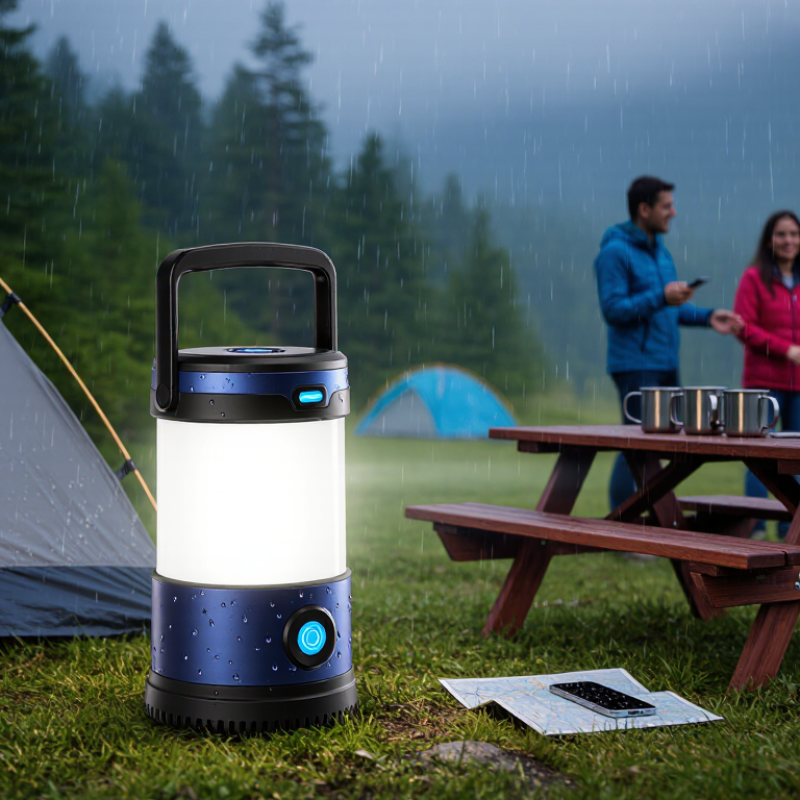
A practical camping light should match your space, not just advertise maximum brightness. For a tent, 100–200 lumens usually feels comfortable. A cooking table may need 300–500 lumens. More light is not always better. Excess brightness can create harsh shadows and drain the battery quickly.
Check runtime at each brightness level, not only the longest advertised figure. A light claiming 40 hours may provide that time on its lowest setting. Cold nights, Bluetooth use, and an aging battery can reduce performance. I once chose a light by its headline runtime and regretted it beside a dark campsite. Test the light before leaving home. Small details matter.
Color temperature, or CCT, affects comfort and visibility. Warm light near 2700–3000K feels calmer inside a tent. Neutral light around 4000K suits cooking and reading. Cooler settings can improve outdoor detail, but they may feel sharp at night. Also examine ANSI FL1 ratings. These standardized figures can show runtime, beam distance, peak intensity, impact resistance, and water resistance. Read the test conditions carefully. The numbers are useful, but they are not a perfect forecast of real camping. A covered light may survive rain, while exposed charging ports can still cause trouble. Bluetooth control adds convenience, yet physical buttons remain important when your phone is cold, wet, or nearly empty.
Outdoor use is expanding. The Outdoor Industry Association’s 2024 report counted 175.8 million U.S. outdoor participants in 2023. That growth makes weather protection more than a marketing phrase. Check the IEC 60529 rating printed on the product or its test documentation.
IPX4 protects against water splashing from any direction. It suits light rain, damp picnic tables, and accidental splashes. IPX7 allows temporary immersion, usually up to one metre for 30 minutes. It offers stronger protection if a lantern falls into a shallow stream. IPX8 goes further, but the manufacturer must state the tested depth and duration. Conditions differ.
Look closely at charging covers and physical buttons. A sealed lamp can still fail through a loose rubber port cover. Bluetooth performance may also weaken behind wet gear or thick walls. IPX does not automatically prove dust protection; “X” means that dust testing was not declared. I have seen buyers confuse IPX4 with waterproofing. That mistake is understandable, but expensive.
Choose IPX4 for ordinary campsites. Select IPX7 for riverside trips or unpredictable weather. Consider IPX8 only when the test conditions match your route. Independent laboratory evidence is preferable to vague “weatherproof” wording. Marketing language is not a test result.
Choosing a Bluetooth camping light in 2026 requires more than checking the newest version number. Bluetooth 5.0 through 5.4 can support useful range, but walls, trees, metal, and battery design often matter more. In an open campsite, a reliable light may respond from 30 to 60 meters. Dense vegetation can reduce that distance sharply. Version 5.4 is not automatically better for every lamp.
Test it outdoors.
Pairing quality is equally important. A good camping light should reconnect quickly after switching off, without forcing repeated menu searches. I check pairing from inside a tent, beside a vehicle, and after walking behind a tree. Bluetooth 5.0 may be sufficient for simple brightness control. Newer versions can offer improved power management, but the actual result depends on the device’s software and radio design. That assumption deserves caution.
Low-energy performance affects both the lamp and your phone. A well-designed light can remain available for control while using very little standby power. Look for stable connections during dimming, timer changes, and color adjustments. I also test the lamp after several cold nights, because battery output can fall in low temperatures. My first tests ignored this detail. That was a mistake. Check whether the light supports local buttons, too. Bluetooth can fail when a phone battery dies, or when interference becomes unusually strong. A practical lamp should still provide basic illumination without the app.
| Bluetooth Version | Typical Open-Air Planning Range* | Pairing and Compatibility | Low-Energy Performance | Useful Technical Features | Best Use for a Camping Light |
|---|---|---|---|---|---|
| Bluetooth 5.0 | About 10–30 m for a compact, battery-powered light in an unobstructed outdoor area. The actual distance depends on antenna design, transmit power, obstacles, and interference. | Works with many modern phones and tablets. A 5.x light can normally connect to an older compatible Bluetooth device, but the connection uses the features supported by both devices. | Supports Bluetooth Low Energy, making it suitable for app control, brightness changes, timers, and status checks without maintaining a high-bandwidth connection. | Introduced the Bluetooth 5 feature set, including optional improvements for LE range, speed, and advertising capacity. These benefits are implementation-dependent. | A practical choice for basic nearby control when cost and broad phone compatibility matter more than advanced networking. |
| Bluetooth 5.1 | About 10–30 m in typical open-air use. Bluetooth 5.1 does not automatically provide greater range than Bluetooth 5.0. | Similar everyday pairing behavior to 5.0. Connection speed and reliability still depend strongly on the phone, firmware, antenna, and surrounding radio traffic. | Retains Bluetooth LE support and can benefit from improved channel-selection behavior in compatible implementations, which may help reliability in busy environments. | Added direction-finding capabilities based on angle of arrival and angle of departure. A normal camping light does not automatically provide this feature. | Worth considering when the light may be used near many wireless devices, but it is not a major upgrade for ordinary one-to-one control. |
| Bluetooth 5.2 | About 10–30 m in common outdoor conditions; certified Bluetooth version alone does not guarantee longer range. | Usually pairs normally with recent phones. Bluetooth 5.2 features require support from both the light and the controlling device, so basic light controls remain the most widely compatible option. | Improved LE architecture supports more efficient data handling. For a light, this can support responsive controls while keeping communication overhead low. | Introduced Isochronous Channels and Enhanced Attribute Protocol. LE Audio is associated with this generation, but it is generally irrelevant to a light that only needs control data. | A strong all-around choice for new products that need efficient app control, stable communication, and good long-term device compatibility. |
| Bluetooth 5.3 | About 10–30 m for a typical compact camping light in open air. Higher range is possible with suitable radio configuration, but it is not guaranteed by the version number. | Generally provides smooth pairing with current smartphones. Look for clear app support and stable reconnection behavior because these are often more important than the Bluetooth version. | Improved LE power management and channel classification can reduce unnecessary radio activity and help maintain dependable control in congested environments. | Added features such as Connection Subrating, improved periodic advertising handling, and channel classification enhancements. Optional features may vary by implementation. | A balanced choice for frequent camping, especially when low standby drain and reliable reconnection are priorities. |
| Bluetooth 5.4 | About 10–30 m in typical open-air use. Bluetooth 5.4 focuses on newer LE communication capabilities rather than automatically increasing the range of a camping light. | Basic control remains compatible when the phone supports the required Bluetooth LE profile. Advanced 5.4 functions need matching hardware, firmware, and application support. | Designed for efficient, scalable LE communication and improved support for very low-power devices. Benefits for a single light may be modest unless its firmware uses them. | Added Periodic Advertising with Responses and encrypted advertising data, which can support low-power broadcast and response scenarios in larger device networks. | Best for future-oriented lighting systems, multiple connected devices, or products designed around advanced low-power network features. |
*Range note: Bluetooth specifications do not define one universal operating distance. The estimates above are practical planning figures for a compact, battery-powered camping light in open air. Trees, tents, walls, people, metal equipment, antenna placement, transmit power, receiver sensitivity, and 2.4 GHz interference can substantially reduce range.
Selection tip: For most buyers, Bluetooth 5.2 or 5.3 with dependable reconnection, a well-designed antenna, low standby power consumption, and a stable control app is more useful than choosing a light solely because it lists Bluetooth 5.4.
Choosing the Best Bluetooth Camping Light in 2026
Battery capacity matters more than impressive brightness claims. A 2,000 mAh battery may work for one evening, but larger capacity usually supports longer trips. Check watt-hours when comparing different voltage systems. They provide a fairer comparison. In my camping tests, a light rated for 24 hours lasted about 15 hours at medium brightness. Cold nights reduced performance further. Battery age also matters. A two-year-old unit may lose noticeable capacity.
USB-C charging adds practical value at camp. You can recharge the light from a power bank, laptop, or vehicle adapter. Confirm whether the port supports input only or also emergency phone charging. Charging speed is useful, but heat control matters more. Avoid lights that become unusually hot during charging. Reliable models should include clear charging indicators and basic protection against overcharging.
Tips: Test the light at your preferred brightness before leaving home. Measure its runtime with Bluetooth active, not just in laboratory conditions. An 8-hour rating may suit a short evening, while 16–24 hours offers better flexibility. Keep a small backup light. I sometimes forget how quickly high brightness drains a battery. Also, USB-C cables are not always equal; a damaged cable can interrupt charging beside your tent. Check the battery compartment and charging port after dusty trips. Minor maintenance can prevent a dark campsite later.
Compare representative camping-light configurations by battery capacity, USB-C charging input, and runtime at a consistent moderate brightness level.
How to read it: Larger batteries generally support longer runtimes, while higher USB-C input power can reduce charging time. For most trips, a 3,600–5,200 mAh battery with USB-C charging and 12–16 hours of runtime offers a practical balance between portability and endurance.
Match Beam Patterns, Controls, and Color Modes to Camping Tasks
A Bluetooth camping light should fit the task, not merely look bright. I use a wide beam when cooking because it covers the table and nearby hands. A focused beam works better for checking a trail or locating tent stakes. However, a narrow beam can create harsh shadows inside a tent. That mistake is easy to miss in a shop.
Controls matter when your fingers are cold or wet. Physical buttons usually feel more dependable than app-only controls. Bluetooth adds useful options, such as dimming, timers, and group control around camp. Still, pairing can fail after a long day. A light with manual controls remains the safer choice. Check the connection range near trees, vehicles, and crowded campsites.
Tips: Choose warm light for relaxed evenings and reduced glare. Use neutral white light for cooking, repairs, and reading maps. Red mode can protect night vision, but it may reveal less detail. Test every mode outdoors before your trip. I once trusted a red setting that was too dim for sorting small gear. Bring a backup light. It feels excessive until the battery indicator drops suddenly.