China Top Turf Rakes Manufacturers for Global Buyers

China’s turf-care equipment market has become increasingly relevant to golf courses, sports fields, landscaping contractors, and municipal grounds teams. Among its expanding product categories, Turf Rakes deserve careful attention. These tools help remove surface debris, level infill, restore loose soil, and improve the appearance of managed grass areas.

Dr. Micah Woods, a respected turfgrass scientist, often emphasizes a practical principle: “Good turf decisions begin with understanding the site.” That idea applies directly to equipment purchasing. A rake designed for sandy bunker maintenance may not suit artificial turf, wet soil, or delicate sports surfaces. Buyers should examine tine material, working width, handle strength, attachment options, and replacement-part availability. Small details matter.

China offers a broad manufacturing base. Some factories focus on simple hand rakes. Others produce adjustable systems, tractor-mounted tools, and customized OEM equipment. Quality, however, is not identical across suppliers. It can vary.

Global buyers should review factory experience, production controls, material specifications, sample performance, packaging standards, and communication reliability. Product photos are useful, but insufficient. A sample should be tested on real turf, especially after rain or repeated passes. This guide introduces leading China Turf Rakes manufacturers and explains how their capabilities may fit different maintenance conditions.

The selection process is not perfectly straightforward. Lower pricing can hide weaker steel, inconsistent welding, or limited after-sales support. Still, careful comparison can uncover dependable partners. Buyers who combine field testing with supplier verification will make more informed decisions and reduce avoidable purchasing risks.
China Top Turf Rakes Manufacturers for Global Buyers

What Makes China a Leading Source of Turf Rakes

China has become a leading source of turf rakes through scale, material access, and flexible production. UNIDO’s International Yearbook of Industrial Statistics 2024 reports that China produced about 31.6% of global manufacturing value added in 2022. This industrial depth supports faster sourcing for steel heads, aluminum handles, springs, and molded grips. It also helps manufacturers serve small landscaping contractors and large distributors.

Production depth matters. A commercial turf rake needs balanced teeth, controlled spring tension, and a handle that remains comfortable after hours of use. Chinese factories often combine stamping, welding, heat treatment, coating, and assembly under one supply network. Buyers can request narrower heads for artificial turf or wider heads for sports fields.

Sample testing should include repeated passes over damp grass, infill, and compacted soil. Real handling reveals problems that catalog photos hide. Not every sample is perfect.

Export infrastructure strengthens this advantage. The World Bank’s Logistics Performance Index 2023 gave China a score of 3.7 out of 5, ranking it 19th globally. That performance supports predictable movement through ports and freight networks. Still, buyers should verify tooth spacing, coating thickness, packaging strength, and replacement-part availability.

A low quotation can conceal thin steel or weak welds. The better suppliers provide inspection records, production samples, and clear tolerances. Some still need improvement in documentation. That gap deserves attention before volume orders begin.

Key Turf Rake Types and Their Professional Applications

Turf rakes differ by tine design, working width, and power source. Each type serves a specific maintenance task. Choosing by price alone often creates uneven results.

Spring-tine rakes remove thatch and loose debris from golf greens, lawns, and sports fields. Their flexible teeth follow gentle contours without cutting deeply. Drag mats spread topdressing and smooth minor surface irregularities. They work well after aeration, especially on compacted training grounds. Tow-behind landscape rakes cover wider areas. Operators use them for seedbed preparation, soil leveling, and light gravel removal. Power rakes provide deeper scarification for renovation work. They require careful depth control.

Synthetic turf needs a different approach. Grooming rakes lift flattened fibers and redistribute infill across busy zones. Excessive pressure can damage backing layers or pull fibers loose. That risk is easy to underestimate. A slow pass is often safer than repeated aggressive passes.

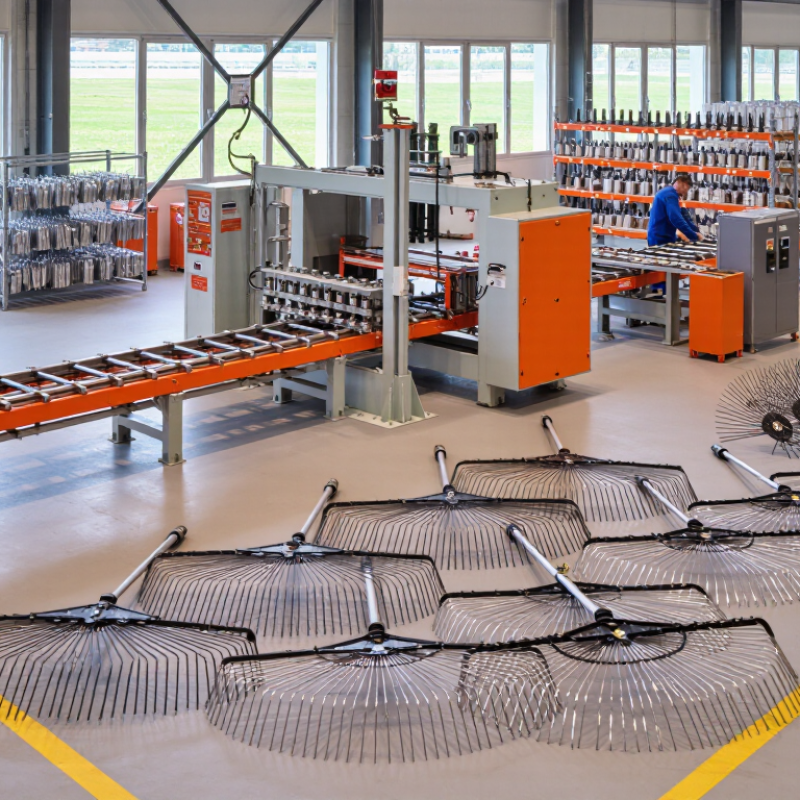
Chinese turf rake manufacturers supply manual, tractor-mounted, and compact powered models for global buyers. Professional purchasers should check tine material, weld quality, adjustment range, and spare-part availability. Request working videos and measured specifications, not only catalog images. Confirm whether stated width means frame width or actual contact width. This small detail can affect transport and labor planning. I would also test a sample unit on the real turf surface. Soil moisture changes performance more than many buyers expect. Some specifications still look impressive but remain unproven in daily field use.

How to Evaluate Chinese Turf Rake Manufacturers

China Top Turf Rakes Manufacturers for Global Buyers

How to Evaluate Chinese Turf Rake Manufacturers

Evaluating Chinese turf rake manufacturers requires more than comparing online prices. Start with factory evidence, production capacity, and product consistency. Request a current business license, factory address, equipment list, and quality-control procedures. Ask for photos of welding, coating, and final inspection areas. A polished catalog is not proof.

Examine the rake itself. Check tine spacing, steel thickness, handle strength, and surface treatment. Ask whether the tines are spring steel, hardened steel, or another material. Request samples from different production batches. Test them on wet soil, thatch, and uneven turf. Watch for bent tines, loose joints, or peeling paint. Small faults become expensive during large-scale distribution. Measure twice.

Reliable manufacturers should provide drawings, tolerances, packaging details, and inspection records. They should explain minimum order quantities, sample charges, lead times, and replacement procedures clearly. Confirm carton strength by checking drop-test results or arranging an independent inspection. Communication also matters. Slow, vague replies may signal weak project control, although language differences can sometimes cause confusion.

Look for experience with export documentation and destination-market requirements. Ask for references from comparable buyers, but verify them independently. No checklist is perfect. A factory may pass an audit and still struggle with a custom design. Keep written specifications, approve a pre-production sample, and define acceptance standards before payment. Supplier evaluation is not only about finding the lowest quote; it is about reducing surprises after the containers leave the port.

Quality Standards, Customization, and Production Capabilities

China’s top turf rake manufacturers serve global buyers through controlled quality standards and practical production experience. Reliable factories inspect steel thickness, tooth spacing, handle strength, coating adhesion, and final assembly. These checks matter because a rake may face wet soil, roots, and repeated impact. Many manufacturers follow documented inspection procedures, while experienced teams also test samples by hand. That human step can reveal loose teeth or uneven welding. Not every factory performs equally well, so buyers should request inspection records and recent product samples.

Customization is a major production capability. Manufacturers can adjust rake width, tooth density, handle length, materials, colors, packaging, and private labeling. Clear drawings reduce mistakes. Technical teams should confirm tolerances before production begins. Large facilities may support stamping, welding, polishing, coating, assembly, and carton packing under one system. This can shorten communication time and improve consistency. However, bigger capacity does not always mean better quality. Buyers should compare trial orders, defect rates, lead times, and replacement policies.

Tips: Ask for material specifications and test reports. Check sample dimensions yourself. Request photos from production stages. Confirm packaging strength for long-distance shipping. A small trial order is safer than trusting polished sales claims. Even experienced buyers can overlook handle comfort, which often affects real customer satisfaction.

China Turf Rake Manufacturing: Buyer Evaluation Framework

A company-neutral reference model for comparing quality standards, customization capability, and production readiness among Chinese turf rake suppliers.

The chart uses a five-point procurement checklist: 1 indicates basic readiness and 5 indicates a highly developed capability. Quality-related factors include documented quality management, material traceability, and inspection procedures. Production-related factors cover customization, tooling, batch consistency, and export packaging. These are reference scores for buyer evaluation rather than data from any specific company or brand.

Export, Pricing, and Supplier Selection for Global Buyers

For global buyers, exporting turf rakes is a specification exercise, not a catalog purchase. The UNCTAD Review of Maritime Transport states that over 80% of global merchandise trade by volume moves by sea. Buyers should confirm carton dimensions, pallet strength, corrosion protection, and port handling before requesting prices. A rake that survives a warehouse may still arrive with bent teeth after a long ocean journey.

Pricing depends heavily on steel, labor, packaging, and freight. The World Steel Association reported global crude steel production of about 1.89 billion tonnes in 2023, showing the scale of this key input market. Ask suppliers for a clear breakdown: ex-works, FOB, or delivered pricing. Compare the same tooth material, handle length, coating, order quantity, and replacement-part policy. A low quotation is not always a saving. In practice, small packaging changes can add surprising freight costs.

Supplier selection needs evidence, not polished photographs. Request recent inspection records, material certificates, load tests, and export references for similar tools. Check whether the factory can maintain tooth spacing across repeat orders. Video inspections help, but they cannot replace random sampling. I have seen acceptable samples followed by inconsistent batches; that risk deserves attention. The 2023 World Bank Logistics Performance Index also shows major differences in customs and delivery reliability between trading markets, so buyers should test communication speed and document accuracy before placing a large order.

China Top Turf Rakes Manufacturers for Global Buyers - Export, Pricing, and Supplier Selection for Global Buyers
The figures below are practical market reference ranges for China-made turf rakes and related lawn-maintenance tools. Final quotations vary according to material, tooling, packaging, order quantity, certification, customization, shipping terms, and destination.
Product Category Typical Construction Working Width Typical Weight Common Applications Indicative FOB China Price Range* Typical MOQ Typical Production Lead Time Export Packaging Key Buyer Selection Criteria
Plastic Leaf and Turf Rake PP or nylon rake head Steel or aluminum handle 420–560 mm 0.45–1.10 kg Artificial turf brushing, leaves, light thatch, residential lawns US$2.20–6.50 per piece 500–2,000 pieces 25–45 days Bulk carton, polybag, or paper sleeve; handle sections may be nested Tooth flexibility, UV resistance, handle locking strength, packed volume
Adjustable Plastic Turf Rake Adjustable tine angle Telescopic handle 300–520 mm 0.60–1.35 kg Artificial grass grooming, narrow garden areas, storage-sensitive retail products US$4.50–11.00 per piece 500–1,500 pieces 30–50 days Individual color box or export carton with protective sleeves Adjustment durability, locking mechanism, retail presentation, replacement parts
Metal Tine Turf Rake Carbon steel or stainless steel tines Powder-coated frame 350–600 mm 0.90–2.20 kg Thatch removal, soil leveling, lawn renovation, heavier garden work US$6.00–16.00 per piece 300–1,000 pieces 30–55 days Carton-packed with anti-scratch separators and moisture protection Steel thickness, tine recovery, weld quality, corrosion protection, balance
Professional Artificial Turf Grooming Rake Wide reinforced head Replaceable bristle or tine system 500–800 mm 1.50–3.80 kg Sports fields, landscaping contractors, commercial artificial lawns US$18.00–55.00 per piece 100–500 pieces 35–60 days Reinforced export carton; disassembled handle where applicable Coverage per pass, serviceability, frame rigidity, bristle wear, operator comfort
Powered Turf Rake Attachment Steel attachment frame Compatible with selected lawn equipment 600–1,200 mm 8–35 kg Large lawns, grounds maintenance, sports turf, tractor or utility equipment US$120.00–650.00 per unit 10–100 units 45–75 days Heavy-duty plywood case or reinforced pallet packaging Attachment compatibility, shaft or hitch dimensions, operating width, spare parts
Handheld Power Turf Rake Electric or battery-powered drive Rotating brush or tine drum 280–450 mm 3.50–8.50 kg Private gardens, small contractors, light thatch and surface debris removal US$65.00–180.00 per unit 50–300 units 40–70 days Color box inside export carton; battery models require transport compliance review Motor output, battery platform, safety documentation, noise level, service network
Custom OEM Turf Rake Buyer-defined geometry Custom color and packaging 300–1,200 mm Specification-dependent Retail programs, distributor ranges, municipal or professional procurement US$3.00–650.00 per unit Usually 500 pieces for hand tools; lower quantities may incur tooling charges 45–90 days after sample and artwork approval Custom carton, barcode label, instruction sheet, pallet or container loading plan Tooling ownership, sample approval, quality-control plan, intellectual-property protection