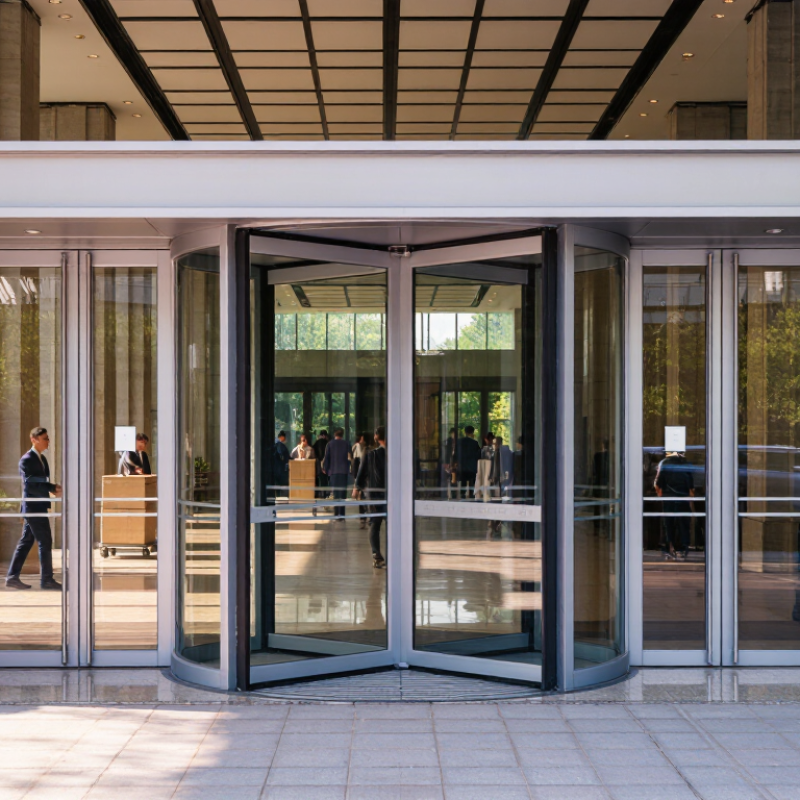
| Typical operation | Power-operated doors open when activated by a sensor, push plate, or other control. They may slide or swing. | Panels rotate around a central axis as people pass through separate compartments. | Panels move horizontally, commonly using an automatic operator and presence sensors. | One or more leaves pivot on hinges; operation may be manual or power-assisted. |
| Best suited to | Entrances needing hands-free access, subject to the selected door configuration and site layout. | High-traffic entrances where continuous pedestrian flow and reduced direct air exchange are priorities. | Hotels seeking a clear, hands-free passage for guests with luggage, where there is enough wall space for the panels. | Lower- to moderate-traffic entrances, or locations where a simple, familiar door arrangement is preferred. |
| Pedestrian flow | Can support convenient passage; capacity depends on the door type, opening width, control settings, and traffic conditions. | Supports steady flow, but each compartment limits how many people can pass at once. Large luggage and groups may slow movement. | Provides a wide, unobstructed opening when fully open; queues may form if the opening is narrow or the door cycles slowly. | Usually accommodates one or a few people at a time; traffic can be interrupted while the leaf swings open and closes. |
| Accessibility and luggage | Can improve hands-free access, but accessible routes, clear opening widths, controls, and safety features depend on the installation and applicable local requirements. | May be difficult for some wheelchair users, people with mobility aids, or guests carrying bulky luggage; provide an accessible alternative where required. | Often convenient for wheelchairs, strollers, and luggage when the clear opening and sensor arrangement are suitable. | Can require users to pull or push the leaf and manage its swing path; accessible hardware or a separate automatic route may be needed. |
| Space and layout | Varies by configuration. Sliding systems need side pockets; swing systems need a clear swing area. | Requires a dedicated circular footprint and sufficient clearance for approach, circulation, and any adjacent accessible route. | Needs space alongside the opening for panels to slide or stack; does not require a door-leaf swing arc. | Needs clear floor area through the swing arc and may affect furniture, queuing, or the lobby layout. |
| Weather and energy considerations | Performance depends on the door design, closing behavior, vestibule, seals, and building conditions. Power operation alone does not guarantee energy savings. | Can limit direct exchange of indoor and outdoor air because it does not leave the full entrance open at once; results depend on the installation and usage. | Frequent or prolonged open cycles can increase air exchange. A vestibule, appropriate controls, and effective closing can help manage it. | A properly fitted, self-closing swing door can help limit drafts when closed; frequent use or doors held open can increase air exchange. |
| Safety and operational planning | Requires suitable sensors, activation controls, and safety features for the specific door type. A manual or emergency-use strategy may also be needed. | Requires clear instructions and safe operating conditions; emergency egress and accessibility provisions must be addressed in the design. | Needs sensors and safety features appropriate to the opening and traffic. Confirm how the system behaves during power loss or emergency use. | Needs clear swing space and suitable hardware. Inward or outward swing direction must be coordinated with circulation and applicable egress requirements. |
| Maintenance considerations | Powered systems need periodic inspection of operators, controls, sensors, and safety devices; service needs vary by design and usage. | Has rotating components and moving panels that need scheduled inspection and adjustment; maintenance access should be considered during design. | Tracks, rollers, sensors, and operators may need regular cleaning, inspection, and adjustment, especially in busy entrances. | Hinges, closers, latches, and seals need periodic inspection; manual systems generally have fewer powered components. |
| Key trade-off | “Automatic” describes powered operation rather than one specific door style, so the performance depends on whether the system slides, swings, or uses another configuration. | Can help manage continuous traffic and air exchange, but takes substantial space and may not suit every guest or luggage type. | Offers a convenient, wide passage, but needs side clearance and careful sensor, safety, and weather-management planning. | Is straightforward and familiar, but requires swing clearance and may be less convenient for hands-free, high-volume traffic. |