What Is the Best Glass Condiment Bottle for 2026?
Choosing the best Glass Condiment Bottle for 2026 involves more than appearance. A clear bottle can show the color and texture of chili oil, vinegar, or dressing. But the right choice also depends on the condiment’s thickness, serving habits, and storage needs. A narrow opening may control a thin sauce, while a wider mouth can make filling and cleaning easier. Small details matter.
Industry data provides useful context, but it cannot choose a bottle for every kitchen. FEVE, the European Container Glass Federation, reported that 80.1% of glass packaging was collected for recycling in Europe in 2021. That figure reflects collection, not the fate of every individual bottle. The Glass Packaging Institute also describes glass as recyclable without loss of quality or purity. Actual recycling outcomes still depend on local collection systems. Worth remembering.
This guide compares practical features: capacity, pour control, closure fit, glass weight, and ease of cleaning. It also considers whether a bottle works with thicker sauces or needs a separate pourer. A handsome bottle is not automatically a useful one. Nor does one design suit every condiment. The best choice depends on how it will be filled, stored, and used. Some trade-offs remain, and product specifications do not always tell the whole story.
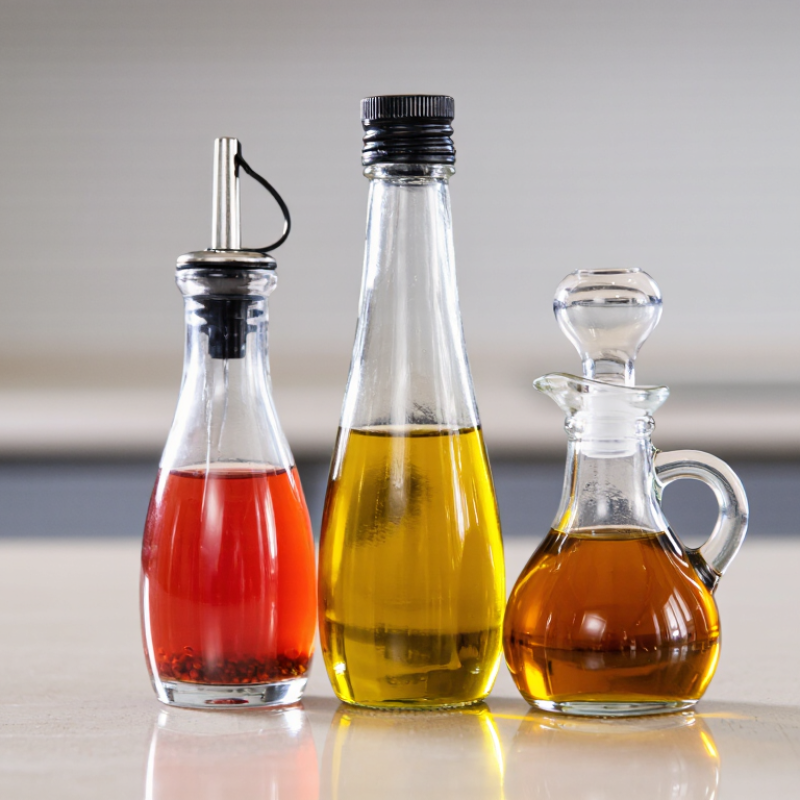
Glass Condiment Bottles: Soda-Lime Glass Has a Density of About 2.5 g/cm³
For a 2026 condiment bottle, soda-lime glass is a practical starting point. Its density is about 2.5 g/cm³, so 100 cm³ of solid glass weighs roughly 250 grams. That is the glass material, not the finished bottle: the actual weight depends on its shape and wall thickness. The European Commission’s 2013 Best Available Techniques Reference Document for the Manufacture of Glass describes soda-lime-silica as the principal glass family used for containers. In use, a sturdy base can help a bottle sit steadily beside a stove, but extra glass also makes it heavier to lift and ship.
Density alone does not tell you whether a bottle is well made. Check the neck finish, cap fit, and wall consistency; a tiny uneven patch can matter when pouring thick sauce. Feel the bottle when it is empty. Too heavy? That may become annoying during daily use. The U.S. Environmental Protection Agency’s 2018 Advancing Sustainable Materials Management report puts glass container recycling at about one-quarter of the amount generated. That figure describes U.S. recovery, not every local system, so verify collection access where you live. I would also avoid treating “thicker” as automatically safer or better. It is a useful reminder, not a complete buying test.
What Is the Best Glass Condiment Bottle for 2026? — Glass Condiment Bottles: Soda-Lime Glass Has a Density of About 2.5 g/cm³
Glass type comparison and practical selection guide for condiment bottles | Glass Type | Typical Density | Typical Linear Thermal Expansion | Practical Characteristics | Best-Fit Use | Selection Consideration |
| Soda-lime glass | About 2.4–2.6 g/cm³; approximately 2.5 g/cm³ is a common reference value. | About 8–10 × 10−6 per °C. | Clear, widely used for food and beverage containers, and suitable for ordinary storage and serving when the bottle is made for food contact. | Best general-purpose choice for many oils, vinegar, sauces, and dressings. | Avoid sudden temperature changes. Confirm that the bottle, closure, and any liner are suitable for the intended food and filling process. |
| Borosilicate glass | About 2.2–2.3 g/cm³. | About 3.3 × 10⁻⁶ per °C. | Its lower thermal expansion generally gives it better resistance to thermal shock than ordinary soda-lime glass. | Special applications involving greater temperature variation, where a suitable bottle design is available. | Thermal-shock resistance does not make a bottle unbreakable. It may be unnecessary for condiments stored and served at ordinary temperatures. |
| Overall recommendation | Soda-lime glass: about 2.5 g/cm³. | Higher than borosilicate glass, so avoid abrupt heating or cooling. | Offers a practical balance for everyday condiment packaging; bottle shape, wall thickness, closure fit, and food-contact compliance also matter. | Choose a food-contact-compliant soda-lime bottle for typical household or food-service use. | For hot filling or repeated temperature changes, follow the bottle maker’s stated temperature limits and filling instructions. |
Values are typical ranges; exact properties vary with glass composition and manufacturing. Density and thermal-expansion figures describe the glass material, not the capacity or strength of a particular bottle.
Food-Contact Safety: EU Regulation 1935/2004 and FDA Requirements
For a 2026 condiment bottle, clear glass is not enough to establish food-contact safety. In the EU, Regulation (EC) No 1935/2004 requires food-contact materials to avoid transferring substances at levels that could harm health or unacceptably change food. The bottle should suit its intended contents, storage time, and filling temperature. Hot sauce poured into a cool bottle is a different use from room-temperature dressing. Details matter.
Check the whole package. The cap, liner, seal, inks, and any decorative coating may contact food or its vapour. Not the whole story. Ask the supplier for a food-contact declaration, traceability details, and supporting test information for the exact bottle and use.
In the United States, FDA requirements depend on the material’s composition and conditions of use; an empty glass bottle is not automatically proof that every closure or coating complies. Ask whether evidence covers oily, acidic, or salty condiments, as relevant.
A common oversight is reviewing the glass specification but not the liner. Paperwork can look complete and still leave that gap.
Bottle Capacity and Shape: Compare Common 100–500 mL Formats
For 2026, compare glass condiment bottles by usable capacity, not just the number printed on the label. A 100 mL bottle suits concentrated sauces, tasting portions, or a table setting where space is tight. Its narrow body can be easy to grip, but a small opening may slow refilling and make thicker sauces awkward to pour. Check the neck and cap together. They matter.
Around 250 mL is a flexible middle size for dressings, syrups, and everyday table sauces. A taller, slim shape saves shelf space, while a wider base feels steadier near a busy cooking area. Bottles in the 400–500 mL range reduce refill frequency for households that use one condiment often. They also take up more room and can feel heavy when full. Leave some headspace; filling to the rim can cause spills when fitting the closure. A rounded shoulder may help liquid drain toward the neck, though thick sauces can still cling to the glass. That part is easy to overlook. Match bottle shape to the sauce’s texture and how it will be poured, then test a filled sample before choosing a larger quantity.
What Is the Best Glass Condiment Bottle for 2026?
Bottle Capacity and Shape: Common 100–500 mL Formats
Smaller bottles suit compact servings and limited storage, while larger formats reduce the need for frequent refills. Round bottles are a familiar all-purpose option; square profiles can pack efficiently on shelves, and cruet-style shapes are designed for pouring. These are representative nominal capacities—availability and dimensions vary by maker.
Closure Compatibility: Understand GPI 28-400 and 38-400 Neck Finishes
For a glass condiment bottle, the neck finish determines whether a closure can engage and seal correctly. In GPI 28-400 and 38-400, the first number indicates the nominal finish diameter in millimeters; “400” identifies a continuous-thread finish. Both use screw-on closures, but their diameters differ. A 28-400 cap will not properly fit a 38-400 neck, even if the cap looks close in size. Small detail. Big consequence.
Choose a closure specified for the bottle’s exact finish, then check its liner and dispensing opening against the condiment. A thin vinaigrette may need a controlled pourer, while a thicker sauce may need a wider opening. The finish alone does not guarantee a leak-resistant seal: liner material, application torque, and bottle tolerances matter too. Ask the supplier for dimensional specifications, and test a filled sample upright and on its side. It is easy to focus on the cap’s appearance; I would not treat that as proof of compatibility. A brief fit test can catch a mismatch before you commit to a full order.
2026 Performance Criteria: Assess Pour Control, Leakage, Cleaning, and Reuse
What Is the Best Glass Condiment Bottle for 2026?
A useful bottle should pour a thin stream, not dump oil onto a salad. Test it with water, then a thick sauce: a narrow, steady flow suits vinegar, while a wider opening may clog less with dressing. Check the cap after several pours. A drip around the neck is easy to miss until it reaches a cupboard shelf. For leakage, fill the bottle, close it, and lay it on its side over a paper towel. Repeat after washing; seals can shift.
Cleaning deserves a real test. Look for a wide enough opening for a bottle brush, few hidden grooves, and a closure that comes apart without force. Glass Packaging Institute industry guidance estimates that using 10% recycled glass in manufacturing can reduce energy use by about 2–3%. That supports choosing durable glass, but it does not prove any individual bottle is easy to reuse. Rinsing promptly matters. Sticky residue hardens fast.
For repeated use, inspect the neck and base for chips, and check whether replacement caps are available. FEVE’s European glass-packaging data reports collection for recycling at around 80%; collection rates vary by country, and recycling is not the same as reuse. A refillable bottle avoids repeated disposal only if it stays clean and leak-resistant. One imperfect detail: clear glass makes residue visible, but it also exposes oil to light. Store it away from a sunny counter.
