10 Best EVA Puzzle Mats for Wholesale Buyers

Wholesale buyers need more than colorful samples and attractive carton prices. EVA Puzzle Mats must perform reliably across gyms, nurseries, playrooms, trade events, and temporary fitness spaces. Thickness, density, interlocking accuracy, surface texture, odor, packaging, and replacement availability all affect the real purchasing decision. A low unit price can become expensive when edges separate, tiles curl, or colors vary between batches.

Materials expert Dr. George Wypych offers a useful principle: “Foam performance depends on structure, not appearance alone.” That idea shapes this guide. Each recommended mat should be assessed through practical details, including compression recovery, water resistance, cleaning effort, and tolerance during repeated assembly. Buyers should also request current specifications, production samples, and clear quality-control records. Trust requires evidence.

Small details matter.

A warehouse manager may notice crushed corners before customers notice the pattern. A daycare operator may focus on cleaning, while a martial arts studio may prioritize shock absorption and stable footing. No single EVA Puzzle Mats design suits every wholesale channel. Some products look excellent but feel too soft under equipment. Others resist wear yet lack comfortable cushioning. This guide compares ten leading options with those trade-offs in mind. It also acknowledges an uncomfortable point: laboratory claims cannot fully predict years of commercial use. Testing, feedback, and periodic review remain necessary. That is imperfect, but more dependable than choosing from photographs alone.
10 Best EVA Puzzle Mats for Wholesale Buyers

What EVA Puzzle Mats Are and Why Wholesale Buyers Choose Them

What EVA Puzzle Mats Are and Why Wholesale Buyers Choose Them

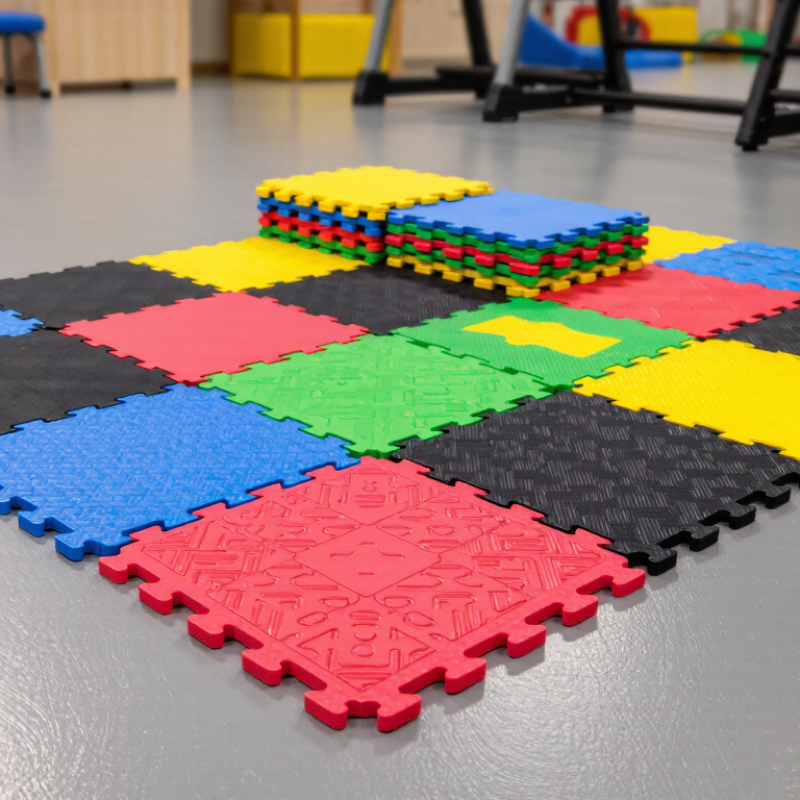
EVA puzzle mats are interlocking floor tiles made from ethylene-vinyl acetate foam. The material is lightweight, closed-cell, and slightly flexible. Each tile usually has teeth-like edges that connect without glue. A 10-millimeter mat can soften pressure under knees and reduce minor impact from dropped equipment. It also creates a warmer surface over concrete floors.

Wholesale buyers choose EVA mats for practical reasons. They are easy to pack, store, and install. A carton of uniform tiles can serve playrooms, fitness studios, childcare spaces, or temporary event areas. Buyers can replace one damaged tile instead of removing the entire floor. This reduces waste and simplifies after-sales service. Color combinations also help distributors meet different project needs.

Quality still requires inspection. Check tile thickness, edge accuracy, surface texture, odor, and compression recovery. Poorly cut edges may separate after repeated use. Some low-density foam can show dents under heavy furniture. It may also expand or shrink with temperature changes. That detail is easy to overlook. In purchasing tests, place samples on a flat floor for several days. Measure gaps, curling, and surface marks. Ask for material information and safety test documents from the supplier. EVA mats are not perfect for every application. Wholesale buyers should match density and thickness with actual use, not only the lowest quotation.

Key Criteria for Comparing EVA Puzzle Mats at Wholesale Scale

10 Best EVA Puzzle Mats for Wholesale Buyers

Wholesale comparison should begin with measurable performance, not surface color. A 2024 Grand View Research assessment valued the global EVA foam market at approximately USD 8.2 billion, with continued growth expected through 2030. That expansion increases supplier choices, but it also creates inconsistent specifications.

Request density, thickness tolerance, compression-set results, and dimensional stability from every factory. A 10 mm mat that measures 8.7 mm after production is not equivalent to a verified 10 mm mat.

Safety data needs equal attention.

ASTM F1292 evaluates impact attenuation, while ASTM F1951 addresses wheelchair accessibility for certain flooring applications. These standards do not automatically certify every puzzle mat. Buyers should request current laboratory reports, test methods, sample conditioning details, and testing dates.

Check slip resistance too, especially for gyms, nurseries, and playrooms where sweat or spilled water may reach the surface. Small details matter.

Packaging can quietly reduce margin.

Compare pieces per carton, carton volume, gross weight, and damage rates during transit. A 2023 packaging industry report from Smithers highlights ongoing pressure to reduce material waste and transport costs across consumer products. Measure pallet utilization before approving a large order.

One weakness remains common: buyers often judge samples under clean showroom conditions. Real floors collect dust, edges separate, and printed surfaces may wear faster than expected. Keep a retained sample, inspect random cartons, and treat supplier claims as evidence to verify, not promises to accept.

Ten EVA Puzzle Mat Types for Different Commercial Applications

Wholesale buyers need EVA puzzle mats matched to real commercial use, not just attractive colors. Ten practical types include standard interlocking mats for gyms, high-density mats for martial arts, cushioned anti-fatigue mats for retail counters, waterproof mats for changing areas, and textured anti-slip mats for busy studios. Wood-look mats suit display spaces, while solid-color mats support schools and daycare rooms. Reversible mats help event contractors change layouts quickly. Extra-thick mats can reduce impact in training zones. Lightweight mats work well for temporary exhibitions and mobile fitness classes.

Tips: Check tile size, edge accuracy, density, odor, and cleaning instructions before placing a large order. Request samples. Test them under actual footwear and equipment.

From experience, installation quality affects performance as much as material choice. Uneven floors can separate puzzle joints, even with reliable EVA foam. Ask suppliers for compression data, thickness tolerance, packaging details, and replacement-piece policies.

Confirm whether the surface remains stable after repeated cleaning. A beautiful pattern may hide scuffing. That matters in commercial settings.

Not every application needs the thickest mat. Excess thickness can create trip concerns near doorways and equipment. Fire performance, accessibility, and local facility requirements should also be reviewed by qualified professionals. Some recycled-content options may vary in color or texture. That is not automatically a defect, but buyers should define acceptable variation before production. Reliable sourcing means testing, documenting, and admitting where a product may fall short.

How to Assess Safety, Durability, Size, and Customization Options

10 Best EVA Puzzle Mats for Wholesale Buyers

Wholesale buyers should assess safety before comparing price or color. Check the EVA composition, odor, surface texture, and edge finish. A strong mat should feel resilient, not sticky or excessively soft. Ask suppliers for recent laboratory reports covering chemical content, slip resistance, and impact performance. Reports should match the exact material and production batch. Do not rely only on a general certificate. Details matter.

Durability depends on density, thickness, and compression recovery. Press a sample repeatedly and inspect whether dents remain. Assemble and separate the puzzle edges several times. Loose joints can create trip points in busy playrooms or fitness areas. Also test cleaning products, sunlight exposure, and temperature changes. A mat may perform well indoors but warp near a hot window. That weakness is easy to miss.

Size and customization require practical planning. Measure the installation area, then allow space for expansion and irregular walls. Common tile dimensions simplify shipping, but larger tiles can reduce installation time. Ask about thickness choices, surface patterns, printed colors, logo placement, and custom packaging. Confirm color consistency across production runs. Request a physical sample, not only digital artwork. One overlooked issue is replacement matching. Keep spare tiles from the same batch when possible. No checklist catches every failure. Recheck assumptions before placing a large order.

10 Best EVA Puzzle Mats for Wholesale Buyers: Safety, Durability, Size, and Customization

Common market configurations are compared by tile width and thickness. Larger tiles can reduce installation time and packaging count, while thicker EVA foam generally provides greater cushioning and floor protection. Buyers should verify safety documentation, material composition, compression recovery, edge accuracy, packaging, and customization capability before placing a wholesale order.

How to Select Reliable EVA Puzzle Mat Suppliers and Manage Orders

Selecting reliable EVA puzzle mat suppliers requires more than comparing unit prices. Grand View Research’s 2023 EVA foam market assessment identified steady demand growth through 2030. This trend attracts new factories, but capacity does not always equal consistency. Request recent production photos, material specifications, and independent test reports. Check EVA density, thickness tolerance, surface hardness, odor, and edge alignment. A 10-millimeter sample should remain close to that measurement across several points. Small gaps become obvious when hundreds of tiles cover a showroom floor.

Ask suppliers how they control color batches and carton compression. The International Trade Centre reports that packaging costs and logistics remain important factors in manufactured-goods trade. Use reinforced cartons, moisture protection, and clear pallet labels. Confirm carton dimensions before booking freight. Then calculate landed cost, not only the factory price. Include sampling, tooling, inspection, transport, duties, and possible replacement units. Keep a written order sheet with approved photos, tolerances, packing counts, and delivery dates. Use staged inspections when the order is large. Before shipment, inspect random cartons and assemble several mats on a flat surface. Do not rely only on a supplier’s checklist. It is convenient, but incomplete.

A practical warning: bright colors can hide surface defects in warehouse lighting. Inspect them under neutral light. Also, a low-odor sample may smell stronger after sealed transport. That risk deserves discussion. Suppliers should explain their material composition and provide documentation for applicable safety requirements in the destination market. Perfect forecasts are rare. Leave a modest buffer for defects and delayed replenishment.

Article Source: