Sorry, your browser is not supported. For a better experience, keep your browser up to date. Check here for latest versions
Choosing the right Battery Powered Pool Vacuum can feel simple until real cleaning begins. A compact model may remove leaves quickly, yet struggle with fine sand on a textured pool floor. Stronger units often clean better, but they may feel heavy near steps, corners, or shallow ledges. Global buyers need more than attractive specifications.
This guide examines practical vacuum types, including handheld cleaners, robotic models, telescopic units, and hybrid designs. It considers suction strength, brush performance, filtration, battery runtime, charging time, and water compatibility. These details matter during weekly maintenance. A vacuum that promises 60 minutes may deliver less when its filter becomes clogged or the debris load increases.
Real pools are rarely perfect.
Pool size, surface material, debris patterns, and storage conditions all influence performance. Regional electrical requirements and manufacturer instructions should also be checked before purchase. Product claims can sound authoritative, but independent testing and user experience deserve equal attention. Some recommendations may not suit every market, especially where replacement filters or batteries are difficult to obtain.
The aim is not to declare one universal winner. It is to help buyers compare useful strengths and realistic limitations. By looking closely at cleaning tasks, battery design, safety features, and after-sales support, readers can make a more dependable choice. Even experienced pool owners may overlook small issues, such as awkward charging ports or filters that are difficult to rinse. This overview keeps those details visible while comparing the top Battery Powered Pool Vacuum types for different global buying needs.
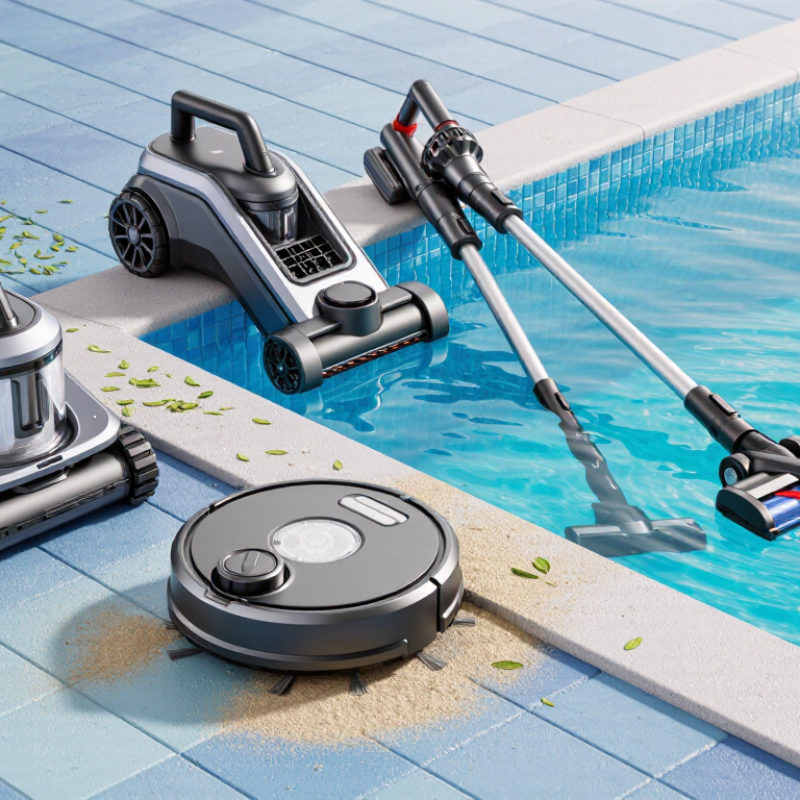
Battery-powered pool vacuums generally fall into three practical categories: robotic, handheld, and pole-mounted units. Robotic models move independently across pool floors, collecting leaves, grit, and fine sediment in an internal basket. Their rotating brushes loosen dirt before suction removes it. Some models climb walls, but performance depends on surface texture and waterline design. Handheld vacuums suit stairs, corners, and small pools. They usually use rechargeable batteries and removable debris chambers. Their compact heads can reach beneath ladders, although cleaning a large pool may require several charging cycles.
Pole-mounted vacuums combine a cleaning head with an extendable handle. They work well for spot cleaning, shallow areas, and pools with delicate finishes. Some use direct suction, while others use water jets to pull debris into mesh bags. The function matters more than appearance. A fine filter captures dust, but it can clog quickly after heavy pollen or algae removal. A larger basket handles leaves better, yet may miss powdery sediment. During practical checks, I consider water clarity, floor shape, and debris size before choosing a category. That habit prevents unrealistic expectations. Not always.
Battery capacity affects runtime, suction stability, and charging time. Buyers should compare tested operating minutes, not advertised capacity alone. Seals, filter access, and battery replacement options also influence reliability. Rinse the filter after each use. Dry contacts before charging. I have found that even strong vacuums can leave dirt around tight drain covers. That is not always a product failure; poor head angles and rushed passes can contribute. Small details matter. Manufacturers should explain these limits clearly.
Pool surface changes how a cordless vacuum moves, seals, and lifts debris. On smooth tile, soft nylon brushes protect grout while steady suction collects fine dust. Vinyl needs gentler contact, because stiff bristles may mark aging liners. Plaster surfaces are tougher, but their texture can slow small wheels. Check that the head remains flat. Poor contact wastes battery power.
Debris type matters just as much as surface. Fine sand needs a tight filter and controlled water flow. Leaves and flower petals require a wider intake, but large pieces can clog narrow ports. Pebbles demand a stronger debris chamber and a head that resists jamming. For algae film, brush agitation matters more than raw suction. A vacuum that excels at sand may struggle with wet leaves. That tradeoff is easy to miss.
Global buyers should compare runtime, charging voltage compatibility, filter cleaning, and replacement-part access. Pool depth also matters; some cordless units lose maneuverability on long telescopic poles. Test the cleaner with debris found around your pool. Marketing charts rarely show muddy corners or overloaded filters. I would not choose the strongest motor automatically. Sometimes it drains faster. Not always. A lighter head may clean steps better, even when its pickup rate seems modest. These compromises deserve honest review.
| Vacuum Type | Best Pool Surfaces | Debris It Handles Best | Typical Cleaning Reach | Typical Runtime | Filtration and Collection | Main Advantages | Important Limitations | Suitability |
|---|---|---|---|---|---|---|---|---|
| Handheld Rechargeable Vacuum | Concrete, fiberglass, vinyl liner, and tiled pools | Sand, silt, small stones, insects, and settled dirt | Most effective on the floor, steps, and shallow areas; extension poles may be required | Approximately 30–60 minutes per charge | Reusable debris chamber with a fine mesh or cartridge filter | Lightweight, easy to control, and suitable for spot cleaning | Usually requires manual operation and may have a smaller debris capacity | ★★★★★ Small pools and routine spot cleaning |
| Telescopic-Pole Cordless Vacuum | Flat concrete, vinyl liner, fiberglass, and smooth tile | Fine dust, leaves, algae residue, and small debris | Designed for floor and wall-edge cleaning with an adjustable pole | Approximately 45–90 minutes per charge | Larger filter bag or debris basket; filter fineness varies by model | Improves operator reach without using a pool hose or power cable | Cleaning performance depends on pole rigidity, head seal, and water depth | ★★★★★ Residential pools and medium-sized areas |
| Robotic Floor Pool Vacuum | Concrete, fiberglass, vinyl liner, and smooth tile floors | Fine sediment, sand, leaves, and general floor debris | Moves independently across the pool floor | Approximately 60–150 minutes per charge | Internal filter basket or cartridge, commonly removable for rinsing | Hands-free floor cleaning and consistent coverage | Many floor-only units do not clean walls, waterlines, or floating debris | ★★★★★ Large flat-bottom pools |
| Robotic Floor-and-Wall Vacuum | Concrete, fiberglass, tile, and compatible vinyl-lined pools | Leaves, sand, fine dirt, and light algae film | Pool floor, angled transitions, selected walls, and sometimes the waterline | Approximately 90–180 minutes per charge | Fine filter cartridge or basket with a sealed internal motor system | Broader coverage and less manual brushing or vacuuming | Wall climbing depends on surface texture, waterline design, wheel traction, and battery capacity | ★★★★★ Pools requiring automated coverage |
| Leaf-Capture Cordless Skimmer | All common pool surfaces because it operates mainly at the water surface | Leaves, flower petals, insects, and other floating debris | Water surface, steps, corners, and perimeter areas | Approximately 30–90 minutes per charge | Large mesh collection basket designed for coarse debris | Removes floating debris before it sinks and reduces skimmer-basket loading | Not designed for sand, silt, algae, or debris settled on the pool floor | ★★★★★ Pools near trees or exposed landscaping |
| High-Suction Cordless Vacuum | Concrete, textured fiberglass, tile, and durable vinyl liner | Heavy leaves, acorns, small pebbles, and compacted debris | Floor, steps, corners, and localized high-debris zones | Approximately 20–60 minutes per charge | Large debris chamber with a coarse-to-medium filter screen | Stronger pickup for heavy debris and faster localized cleaning | Higher suction can make movement harder on delicate or loose vinyl liners | ★★★★☆ Pools with heavy coarse debris |
| Fine-Filter Cordless Vacuum | Smooth fiberglass, tile, polished concrete, and well-maintained vinyl liner | Dust, pollen, fine sand, dead algae, and very small particles | Floor, steps, and shallow wall sections depending on the head design | Approximately 30–75 minutes per charge | Fine mesh or pleated cartridge; requires regular rinsing to maintain suction | Better water clarity after removing small suspended or settled particles | Fine filters can clog quickly when used on leaves or large debris | ★★★★☆ Pools with sediment or pollen buildup |
| Multi-Head Convertible Vacuum | Concrete, fiberglass, tile, and vinyl liner when the correct head is used | Leaves, sand, silt, insects, and light algae residue | Floor, steps, corners, and selected wall areas | Approximately 40–100 minutes per charge | Interchangeable heads with a reusable basket or filter system | Flexible cleaning for mixed surfaces and different debris sizes | Changing heads and filters takes additional time; performance is usually less specialized | ★★★★☆ Buyers managing varied pool conditions |
For global buyers, battery performance should be judged by usable cleaning time, not voltage alone.
The U.S. Department of Energy’s 2024 battery technology overview places current lithium-ion cell energy density broadly around 150–250 Wh/kg. A pool vacuum still loses energy through motor load, clogged filters, and moving water. A 100 Wh battery may therefore deliver 30–60 minutes in real use, depending on debris and depth. Treat laboratory runtime as optimistic.
Suction needs a measurable specification.
Look for water-lift pressure, flow rate, and brush design together. High suction can remove wet leaves, but excessive force may drain the battery quickly. Filtration matters just as much. A fine mesh captures sand and algae, while a larger basket handles leaves without blocking rapidly. Check filter capacity, washing instructions, replacement availability, and drying time. A clear debris chamber is useful in bright outdoor conditions.
Water resistance requires careful reading.
IEC 60529 defines IP protection ratings, but an IP rating alone does not certify continuous underwater operation. Ask for the rated immersion depth and test duration. I would also compare charging temperature limits across regions. This checklist is not perfect; manufacturers often report different test conditions. My own buying mistake was trusting maximum suction before checking filter blockage. That choice reduced cleaning time sharply. For international use, choose a removable battery, multilingual instructions, and a charger compatible with local voltage systems.
Top Battery Powered Pool Vacuum Types for Global Buyers
Handheld, robotic, and hybrid pool vacuums solve different cleaning problems. Handheld models are light, affordable, and useful for steps, corners, and small above-ground pools. Their cleaning time depends heavily on battery capacity and debris volume. Robotic units move independently across the floor and often climb walls. They suit larger pools, but their filters, wheels, and charging systems need regular inspection. Hybrid designs combine manual control with partial automation. They can reach awkward areas, although their added mechanisms may increase repair costs.
Fortune Business Insights’ 2024 Robotic Pool Cleaner Market report projects strong market growth through 2032, reflecting rising demand for automated maintenance. Energy use also matters. ENERGY STAR reports that variable-speed pool pumps can reduce energy consumption by up to 80% compared with single-speed models. This does not measure vacuum performance directly, but it supports a broader efficiency lesson. Battery capacity, filtration speed, and charging losses deserve attention. More automation is not always better.
Tips: Check the local voltage standard, warranty coverage, and replacement-filter supply before importing. Test the vacuum on tile, liner, and rough concrete if possible. A handheld unit may outperform a robot in a narrow pool. That is easy to overlook. Ask for measured runtime, charging time, and debris capacity. Some advertised figures use ideal conditions, not wet leaves and sand. My practical preference is cautious: choose the simplest design that matches pool size, surface, and cleaning frequency.
Comparing Handheld, Robotic, and Hybrid Pool Vacuum Designs
The chart compares representative, non-branded specifications commonly published for battery-powered pool vacuums. Robotic models generally provide the longest runtime and largest recommended cleaning area, while handheld designs are lighter and easier to carry. Hybrid models balance portability with broader cleaning capability.
Top Battery Powered Pool Vacuum Types for Global Buyers
Battery-powered pool vacuums usually fall into three groups: handheld models, wheeled cleaners, and autonomous units. Handheld designs suit steps and narrow corners, while wheeled types cover larger flat surfaces faster. Autonomous cleaners reduce manual work, but their sensors may struggle with dark liners, curved walls, or heavy leaves. I have found that “cordless” does not mean risk-free. Water, charging ports, and rushed handling still create avoidable hazards.
The World Health Organization reported more than 236,000 drowning deaths globally in 2021. A vacuum cannot replace supervision, barriers, or safe pool procedures. Buyers should check the enclosure rating under IEC 60529, but an IP rating is not a promise of unlimited waterproofing. Keep the charger away from splash zones. Remove the battery before cleaning, and inspect seals for sand or cracks. Small details matter.
Maintenance affects both safety and service life. Rinse the intake after chlorine or saltwater use, empty the debris chamber before storage, and dry metal contacts completely. Battery performance may decline in very cold warehouses or hot delivery vehicles. Purchasing decisions should include local charging voltage, replacement filters, battery availability, warranty support, and clear safety instructions. For lithium batteries, verify transport documentation and testing references such as UN 38.3 and IEC 62133-2. The U.S. CPSC recorded an average of 358 child drowning deaths and 6,500 emergency-department injuries linked to pools and spas annually from 2019 to 2021. Those figures are U.S.-specific, yet they challenge the assumption that convenience alone defines value.