Sorry, your browser is not supported. For a better experience, keep your browser up to date. Check here for latest versions
Selling bedding across Europe requires more than attractive fabric and careful stitching. EU Market Compliant Bedding must meet safety, chemical, labeling, and traceability expectations before it reaches a customer’s bedroom. A duvet may look simple, yet its filling, dyes, fasteners, packaging, and care label can create separate compliance questions.
Dr. Lutz Walter, a textile technology specialist associated with EURATEX, has said, “Traceability is the backbone of trustworthy textile production.” That principle guides this practical introduction to seven essential tips. The process begins with identifying every fiber and component. It continues through supplier checks, risk assessment, laboratory testing, and accurate textile labeling. REACH restrictions deserve close attention, especially when finishes, prints, or treated materials are used. Keep test reports and supplier declarations together. Small gaps can become expensive delays.
Details matter. A factory record should connect a finished sheet to its yarn, dye lot, production date, and inspection result. Packaging claims should match the product inside. Care instructions should be readable after washing, not merely attractive on a sales page. Depending on the product and market, additional national requirements may also apply. Confirm current rules with qualified compliance professionals or accredited testing laboratories.
No checklist is perfect. Suppliers change. Rules develop. Human mistakes happen. That is why responsible brands review their files regularly and challenge their own assumptions. The following seven tips offer a clear working structure, while leaving room for better questions, stronger evidence, and more careful decisions.
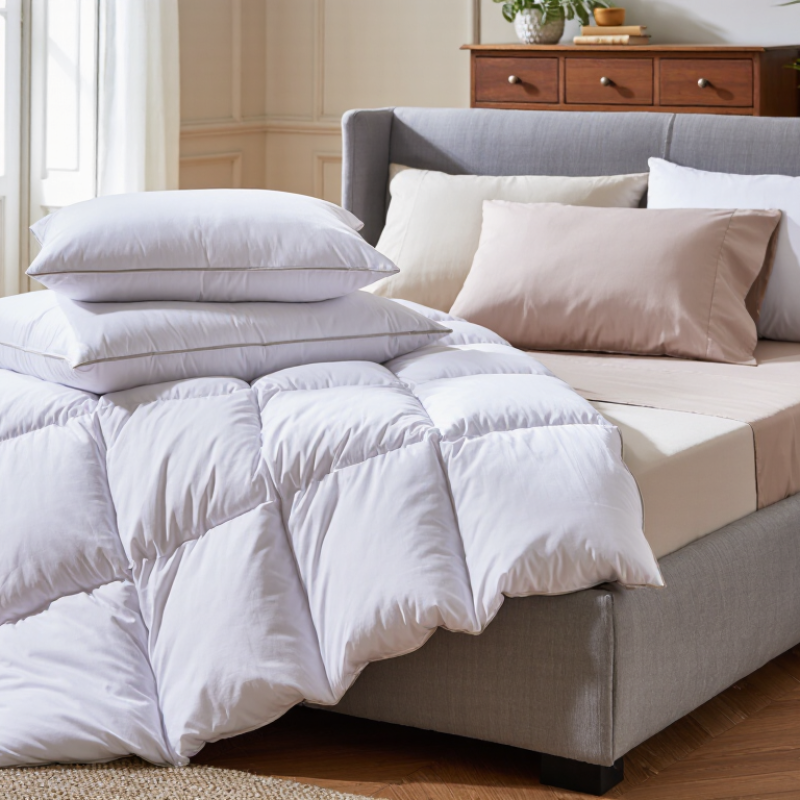
7 Tips for EU Market Compliant Bedding
Define EU Scope Under GPSR (EU) 2023/988, Effective 13 December 2024
From 13 December 2024, the General Product Safety Regulation applies to non-food products offered to EU consumers. Tip 1: define scope by destination, not warehouse location. A duvet sold through an online listing targeting France may enter the EU market, even when shipped elsewhere. Tip 2: identify the manufacturer, importer, distributor, and EU-based responsible person. Tip 3: map related requirements, including textile labelling, chemical restrictions, and packaging obligations. GPSR may operate alongside these rules.
Tip 4: document a bedding-specific risk assessment. Check filling migration, loose threads, choking hazards, overheating, flammability, and foreseeable misuse. Small details matter. Tip 5: maintain technical records, test reports, supplier declarations, and production controls. Keep them organised and accessible. Tip 6: build traceability into labels, batch codes, and sales records. A plain batch number can save hours during an investigation. Tip 7: write clear warnings and care instructions in the language required for each destination market. Online product pages also need meaningful safety information, not only attractive photographs.
Review marketplace listings, packaging, and physical samples together. They often tell different stories. An internal review should test normal use and reasonably foreseeable misuse. No checklist catches every risk. Materials can change, suppliers can overlook a specification, and wording may become outdated. Create a process for complaints, corrective action, and serious incident reporting, then review it after real customer feedback.
7 Tips for EU Market Compliant Bedding
Tips 1–2: Apply Fibre Labels Under Regulation (EU) No 1007/2011
Tip 1: Verify every fibre name and percentage before printing. Bedding labels should use authorised textile fibre names, not vague terms such as “soft blend” or “natural fabric.” List fibres in descending order by weight. For example, “60% cotton, 40% polyester” is clearer than a promotional description. Keep supplier specifications, test reports, and production records together. Small errors become expensive later.
Tip 2: Make the label durable, visible, and understandable. It should remain attached through normal handling and clearly show the fibre composition. Use the official language requirements for each EU country where the bedding is sold. A multilingual label may reduce relabelling work. Check punctuation and percentages carefully. They matter.
In practice, compliance reviews often reveal confusion between the cover fabric and the filling. They may require separate documentation or wording, depending on the product design and applicable scope. Do not assume one label covers every component. Confirm the construction, calculate fibre percentages accurately, and review any permitted tolerance before approval. Care instructions are useful, but they do not replace fibre information. A final human check is still worthwhile, because automated templates can repeat one mistake across thousands of labels.
| Tip / Compliance Area | EU Requirement | Bedding Example | Practical Compliance Check |
|---|---|---|---|
| Tip 1: Identify the textile product | Regulation (EU) No 1007/2011 applies to textile products and products containing at least 80% textile fibres by weight. The fibre composition must be communicated to consumers through an appropriate textile label or marking. | A duvet cover made from 100% cotton, or a fitted sheet made from 95% cotton and 5% elastane, falls within the typical scope of the regulation. | Confirm the product’s textile-fibre percentage by weight and determine whether the label applies to the complete product or to separately identifiable textile components. |
| Tip 1: Use authorised fibre names | Fibre names must correspond to the names listed in Annex I to Regulation (EU) No 1007/2011. Marketing descriptions must not replace the legally required fibre names. | Use “cotton,” “linen,” “polyester,” “polyamide,” or “elastane” where applicable, rather than using only terms such as “natural fabric,” “microfibre,” or “stretch.” | Compare every fibre term on the label with the current Annex I terminology before artwork approval and translation. |
| Tip 1: State the fibre percentages | The label must state the percentage by weight of each fibre present in the product, using clear and legible wording. | “100% Cotton” “60% Cotton, 40% Polyester” | Ensure that the percentages are supported by the product specification, bill of materials, and relevant fibre-composition test documentation. |
| Tip 1: List fibres in descending order | Fibre names and percentages must generally be listed in descending order by weight. | Correct: “70% Cotton, 25% Polyester, 5% Elastane.” Incorrect order: “5% Elastane, 70% Cotton, 25% Polyester.” | Check that the order shown on the label matches the final tested or technically documented composition. |
| Tip 2: Label minor fibre content correctly | A fibre representing less than 5% of the total weight, or fibres collectively representing less than 15%, may be designated as “other fibres” in accordance with the regulation’s conditions. The applicable total percentage must be stated. | A bedding fabric containing 96% cotton, 3% polyester, and 1% elastane may, where the legal conditions are met, use wording such as “96% Cotton, 4% Other Fibres.” | Do not use “other fibres” merely for convenience; verify the threshold, the number of fibres involved, and the final percentage calculation. |
| Tip 2: Declare non-textile parts of animal origin | Products containing non-textile parts of animal origin must be labelled or marked with the phrase “Contains non-textile parts of animal origin.” | A duvet or decorative bedding item containing a feather filling, or a textile product with a genuine leather trim, may require this statement. | Review fillings, trims, patches, buttons, and other components. Do not treat animal-derived components as textile fibres. |
| Tip 2: Make the label legible and available at sale | Fibre-composition information must be durable, easily legible, visible, and accessible to the consumer. It should be presented in the official language or languages required in the Member State where the product is made available to consumers. | A sewn-in label on a duvet cover or a securely attached label on a sheet should remain readable during normal handling and be available before purchase where required. | Check attachment strength, contrast, print durability, online product-page information, and the language requirements of every intended EU market. |
| Documentation and release control | The responsible economic operator should be able to demonstrate that the fibre information reflects the product placed on the EU market and that the label is consistent with the applicable regulation. | Keep the approved composition, supplier declarations, test reports, label artwork, translations, and production-control records for each bedding style. | Introduce a pre-production label review and a change-control process whenever yarns, fabrics, fillings, trims, or suppliers change. |
Regulatory reference: Regulation (EU) No 1007/2011 on textile fibre names and related labelling and marking of the fibre composition of textile products.
For EU bedding, Tip 3 begins with a material map, not a supplier promise. List every fabric, foam layer, zipper, coating, thread, print, and filling. Each may be an article or part of a complex product under REACH. The 0.1% SVHC threshold is assessed by weight at the relevant article level. If an SVHC exceeds 0.1%, Article 33 communication duties may apply. Buyers should receive safe-use information, including the substance name when required.
Ask suppliers for dated declarations tied to the batch, composition, and production site. Do not accept a generic “REACH compliant” statement without supporting records. Check the current Candidate List before each major design or sourcing change. A laboratory screen can help, but it cannot replace supply-chain evidence. For foam, dyes, prints, and water-repellent finishes, use risk-based testing. Keep reports, invoices, specifications, and corrective actions in one traceable file.
In practice, testing often finds uncertainty, not a clear answer. That is uncomfortable. A supplier may change a finish without changing the product code. I have seen teams test the cover while overlooking elastic or printed labels. That gap can weaken a carefully prepared technical file. If an SVHC is confirmed above 0.1%, pause release and obtain accurate communication data. Review customer notification and SCIP obligations with a qualified EU compliance professional. Requirements and Candidate List entries can change.
Tip 4: Test ignition resistance under EN ISO 12952 Parts 1–2. Part 1 evaluates smouldering cigarette ignition. Part 2 examines ignition from a small flame. Both methods reflect realistic bedding fire scenarios.
Use the complete product assembly. Include the cover, filling, seams, closures, and protective layers. Test laboratories should follow controlled conditioning and calibrated procedures. An accredited ISO/IEC 17025 laboratory can strengthen technical reliability. The UK Home Office recorded approximately 28,600 dwelling fires in England during the year ending March 2023. Product details still matter.
Tip 5: Treat test reports as product-specific evidence. A passing result for one filling weight cannot automatically cover another design. Review every material change, including recycled fibres, quilting density, and fabric finishes. That assumption deserves challenge. Keep sample identification, conditioning records, photographs, and laboratory observations together.
EN ISO 12952 results support risk assessment, but they do not replace market-specific requirements. The European Commission’s General Product Safety framework expects manufacturers to consider reasonably foreseeable use. Bedding may be folded, layered, or placed near heat sources. These details should appear in internal testing plans. A practical review should ask whether the tested sample truly matches the retail product. Often, it does not.
EN ISO 12952 uses two standardized ignition-source methods for bedding products: a smouldering cigarette in Part 1 and a small gas flame in Part 2.
How to read the chart: Each method uses one defined ignition-source category. The tested bedding assembly is assessed for ignition, progressive smouldering and flaming according to the applicable standard procedure. The chart describes the test scope and is not a pass/fail result.
The label should reflect the tested composition, not a purchasing description. Check the percentages of down, feathers, and other components. Use the correct terminology and product category.
Request a laboratory report for the actual filling lot. Match its date, lot number, and sample description with production records. Keep sealed reference samples when possible. A carton marked “90% down” means little if the report covers another shipment.
Small details matter.
This standard addresses feather and down fillings used in bedding products. Confirm that the filling, fabric construction, manufacturing controls, and product information meet the applicable requirements. Do not rely on a supplier declaration alone.
Inspect several finished units from different cartons. Look for uneven filling, leaking feathers, unclear fibre content, or labels that differ from the technical file. Photograph the label beside the batch code. It creates a useful audit trail.
A spreadsheet can still be wrong. One overlooked revision may create inconsistent claims across packaging and online listings. Have an experienced compliance reviewer compare test reports, labels, purchase orders, and final samples. If the documents conflict, pause release and investigate the cause.
Standards may be updated or interpreted differently across projects. Obtain the current editions and seek qualified testing advice when the filling contains blended or unusual materials. Credible verification is not paperwork alone; it is evidence that connects the claim to the product in your hands.