The 2026 Top Organic Socks Suppliers for Global Buyers guide examines manufacturers that combine responsible materials, reliable production, and transparent sourcing. Organic Socks are not judged by softness alone. Buyers should examine fiber content, certification scope, factory conditions, dyeing methods, and shipment consistency.
La Rhea Pepper, a respected organic cotton advocate and former Textile Exchange leader, describes organic cotton as “a system that supports soil, farmers, and communities.” This perspective matters when comparing suppliers. A GOTS certificate can support material and processing claims, but buyers should still verify its license number, product scope, and validity. OCS certification may confirm organic fiber content, yet it does not cover every stage of manufacturing. Details matter.
This guide focuses on practical supplier evidence. It considers sample quality, minimum order quantities, private-label capabilities, packaging options, lead times, and communication during production. A strong supplier should explain where the cotton was grown and how socks were knitted, dyed, inspected, and packed. Buyers may also request audit records, test reports, and updated certification documents.
No supplier is perfect. Some factories offer excellent traceability but require higher minimum orders. Others provide flexible sampling but limited color options. That trade-off deserves attention. Even a polished sustainability presentation can hide gaps in documentation. Global buyers should compare claims with records, physical samples, and clear commercial terms. These suppliers are selected as useful starting points, not unquestionable winners, because responsible purchasing requires verification at every stage.
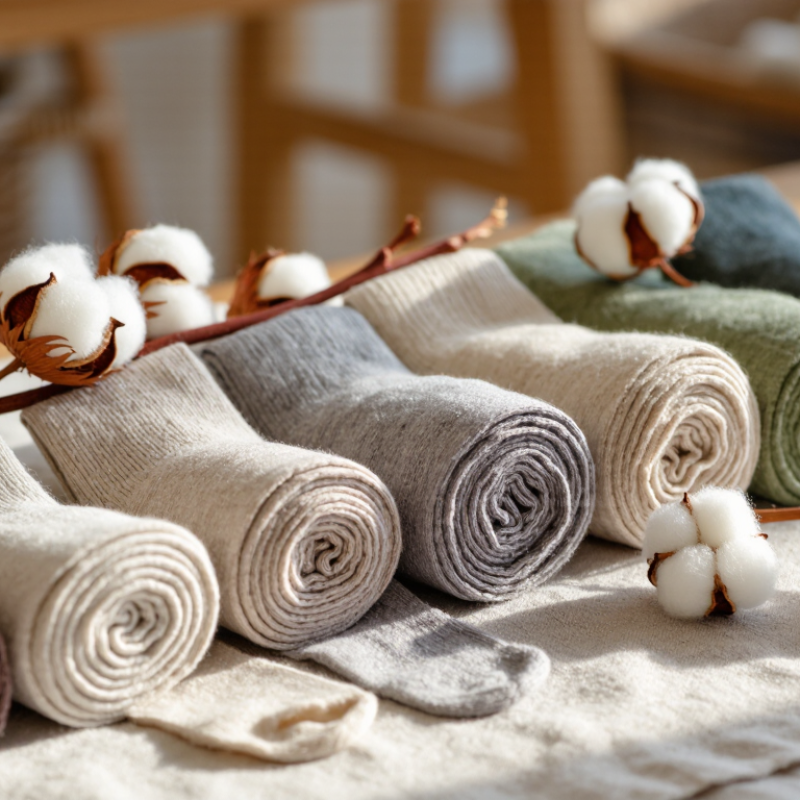
Organic socks are made from fibers grown without most synthetic pesticides, prohibited fertilizers, or genetically modified seeds. Organic cotton is the most common choice, while organic wool and bamboo blends also appear in international sourcing. However, “organic” describes the fiber, not always the complete sock. Dyeing, stitching, packaging, and transport still affect the product’s environmental footprint.
Global buyers often choose organic socks for their softer hand feel and clearer material traceability. A well-made pair should feel smooth inside, hold its shape after washing, and resist thinning at the heel. These details matter for retailers, hospitality groups, and uniform suppliers managing repeated customer use. Buyers should request current certificates, fiber percentages, test reports, and production samples. Paperwork alone cannot reveal whether the elastic stays comfortable after several washes.
Reliable suppliers can explain where fibers were grown, spun, dyed, and finished. They should also provide testing for colorfastness, shrinkage, seam strength, and harmful chemical residues. Independent certification may support these claims, but standards differ by market and product category. That part is easy to overlook. Organic socks may cost more because certified farming, careful processing, and smaller production runs require investment. Yet the higher price does not guarantee longer life. Buyers should compare wear tests, defect rates, packaging choices, and delivery consistency before placing large orders. A practical trial order often exposes problems that a polished catalog hides.
The table compares supplier categories and purchasing criteria commonly used by international buyers. It focuses on material composition, recognized certifications, production capabilities, and documentation rather than company or brand names.
| Rank | Supplier Category | Primary Organic Fiber | Typical Product Range | Relevant Certification Route | Best Fit for Buyers | Documents to Request | Main Purchasing Advantage |
|---|---|---|---|---|---|---|---|
| 1 | Certified Organic Cotton Sock Supplier | Organic cotton, often blended with recycled polyester, elastane, or polyamide for durability and stretch | Crew socks, ankle socks, quarter socks, athletic socks, dress socks, and baby socks | GOTS or OCS; GOTS products labeled “organic” generally require at least 95% certified organic fibers, while “made with organic” generally requires at least 70% | Retailers, private-label programs, eco-conscious fashion brands, and hospitality buyers | Scope certificate, transaction certificate where applicable, fiber composition, dyeing details, and test reports | Broad market acceptance, comfortable hand feel, and reliable year-round demand |
| 2 | Organic Cotton Performance Sock Supplier | Organic cotton combined with recycled synthetic fibers and a small amount of stretch fiber | Cushioned sports socks, running socks, hiking socks, compression-style socks, and work socks | GOTS or OCS for organic fiber content; additional product testing may cover colorfastness, abrasion, and dimensional stability | Sports retailers, outdoor distributors, wellness companies, and uniform programs | Material breakdown, performance test reports, restricted-substance test results, and production samples | Combines organic-content claims with cushioning, moisture management, and improved wear resistance |
| 3 | Organic Merino Wool Sock Supplier | Certified organic wool, commonly blended with polyamide or elastane for strength and fit | Thermal socks, hiking socks, ski socks, boot socks, and winter lifestyle socks | GOTS or other recognized organic-wool certification; animal-welfare and mulesing policies should be checked separately | Outdoor brands, winterwear retailers, travel companies, and premium natural-fiber programs | Organic-wool certificate, animal-welfare policy, fiber origin statement, yarn specification, and test reports | Natural temperature regulation, odor resistance, and strong cold-weather performance |
| 4 | Organic Cotton Baby and Kids’ Sock Supplier | Organic cotton, with soft elastane or recycled-fiber content depending on the design | Non-slip socks, turn-cuff socks, school socks, ankle socks, and seamless styles | GOTS or OCS; children’s products should also be assessed against destination-market chemical and product-safety rules | Baby retailers, children’s apparel distributors, family lifestyle stores, and gift suppliers | Certification documents, azo-dye and restricted-substance tests, size chart, grip-material specification, and labeling files | Softness, skin-comfort positioning, and strong demand for traceable children’s textiles |
| 5 | Organic and Recycled Fiber Sock Supplier | Organic cotton or organic wool combined with recycled polyester or recycled polyamide | Everyday socks, athletic socks, work socks, fashion socks, and promotional programs | GOTS or OCS for organic fibers, plus GRS or RCS for recycled-content claims when applicable | Buyers seeking lower-impact material mixes and documented recycled content | Organic certification, recycled-content certificate, transaction documentation, composition report, and chain-of-custody records | Balances natural-fiber comfort with improved durability and resource-efficiency claims |
| 6 | Organic Hemp Blend Sock Supplier | Organic hemp blended with organic cotton, recycled fibers, or a small amount of elastane | Casual socks, summer socks, lifestyle socks, and lightweight work socks | GOTS or OCS where the complete product and supply chain meet the applicable requirements; fiber claims must be verified | Sustainable lifestyle retailers and buyers looking for differentiated natural-fiber products | Fiber-origin documentation, certification scope, blend percentage, shrinkage test, and colorfastness report | Distinctive texture, breathable construction, and product differentiation beyond standard cotton socks |
| 7 | Custom Private-Label Organic Sock Manufacturer | Organic cotton, wool, hemp, or certified blends selected according to the buyer’s specification | Custom colors, jacquard patterns, logo knitting, packaging variations, and multiple size grades | Certification depends on the selected fiber and processing route; product claims must match valid transaction and scope documentation | Importers, department stores, e-commerce sellers, uniform buyers, and multi-country retail programs | Pre-production sample, approved tech pack, certification scope, test reports, packaging artwork, and inspection records | Greater control over design, packaging, sizing, and market-specific labeling requirements |
