Battery Powered tools have moved well beyond lightweight drills. Today, global buyers can compare cordless saws, impact drivers, grinders, garden tools, and complete platform systems. The strongest choice is rarely the tool with the biggest voltage number. Battery capacity, motor design, charging speed, weight, and service support all matter. On a jobsite, a spare pack can keep work moving. In a small workshop, that same pack may add unnecessary cost.
Battery-tool specialist Alex Morgan puts the buying principle this way: “Choose the platform for the work you repeat, not the specification that looks best on paper.” Buyers should compare real tasks, expected runtime, and battery compatibility across tools. Check charger availability and replacement-pack access in the intended market. A compact drill may suit overhead installation, while a high-torque impact wrench can save effort on demanding fasteners. Feel the grip, too. Numbers cannot tell you how a tool balances in one hand.
This 2026 guide examines leading options for different budgets, workloads, and buyer needs. It also considers durability, safety features, warranties, and practical ownership costs. Product specifications can change by region, and published runtime figures rarely match every job. That matters. No single platform is best for everyone. A lower-priced kit may be the sensible choice for occasional work, though long-term support deserves a closer look. The trade-offs are not always neat. We compare them so global buyers can make a more informed decision.
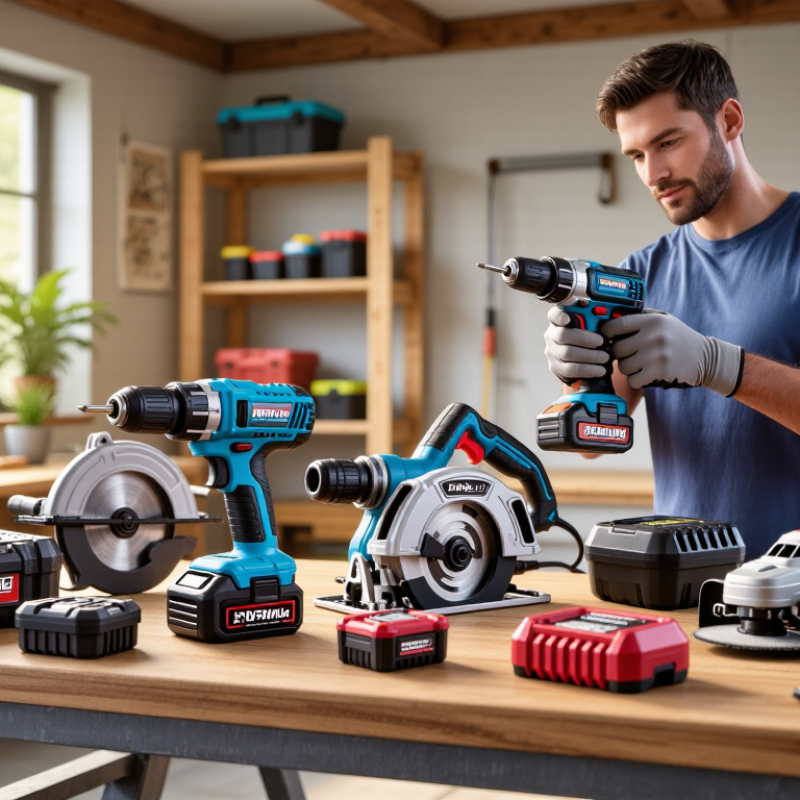
2026 Top Battery Powered Tools for Global Buyers
Battery-Powered Tools: Core Components and Operating Principles
A cordless tool’s power path starts in its battery pack. Multiple lithium-ion cells store energy; their series and parallel connections shape voltage and capacity. A battery management system monitors cell voltage, temperature, and current, then limits output when conditions become unsafe. BloombergNEF’s 2023 Battery Price Survey reported a global lithium-ion pack average of $139 per kilowatt-hour, down 14% from 2022. That figure covers the broader battery market, not tool-pack prices.
When the trigger is pressed, an electronic controller meters current from the pack to the motor. The motor turns electrical energy into rotation, while gears trade speed for torque. A drill’s gearbox, for example, helps deliver slower, stronger rotation for driving screws. Heat matters. Dust and repeated high-load use can also stress vents, contacts, and gears. Small details count.
For buyers, compare voltage, amp-hour capacity, pack weight, and protection features together; a larger capacity often adds weight. Check whether the tool maintains output under load, not just its no-load speed. Battery-price trends offer useful context, but they cannot predict runtime or durability in a specific tool. That part needs testing. Room for uncertainty remains: user technique, material, and temperature all change real-world performance.
A practical overview of common cordless tool categories, their main components, and how those components work together. Specification ranges are indicative and vary by model and application.
| Tool Category | Typical Applications | Core Components | Operating Principle | Common Battery Platform | Key Buying Considerations |
|---|---|---|---|---|---|
| Drill / Driver | Drilling holes in wood, metal, and plastics; driving screws and fasteners. | Battery pack, electronic controller, motor, reduction gearbox, adjustable clutch, chuck, and trigger switch. | The motor turns the gearbox, which reduces speed and increases torque. A clutch can limit torque to help prevent overdriving fasteners. The chuck grips drill bits or driver accessories. | Commonly 12 V or 18 V nominal lithium-ion platforms; compact and high-capacity battery packs are widely used. | Check chuck capacity, clutch settings, speed range, torque suitability, and whether the battery platform is shared with other tools. |
| Impact Driver | Driving long screws, lag bolts, and other fasteners where brief high torque is useful. | Battery pack, motor, reduction gearing, rotating hammer-and-anvil mechanism, electronic control, and hex collet. | The motor spins a hammer assembly. When resistance rises, the hammer repeatedly strikes an anvil, delivering short rotational impacts to the fastener. | Often 18 V nominal; lower-voltage compact models are also available. | Compare fastening control modes, impact rate, tool size, noise, and accessory compatibility. High torque is not a substitute for correct fastener selection. |
| Circular Saw | Straight cuts in sheet goods, lumber, and other compatible materials. | Battery pack, motor, blade, spindle, guard, base plate, and electronic protection circuitry. | The motor rotates a toothed blade at high speed. The blade removes material as it passes through the workpiece; the base plate guides the cut and the guard covers the blade when not cutting. | Commonly 18 V nominal for compact saws; higher-voltage platforms are used in some larger or demanding models. | Check blade diameter and bore, cutting depth, bevel range, blade availability, and suitability for the material and duty cycle. |
| Angle Grinder | Grinding, deburring, and cutting with an accessory rated for the tool and application. | Battery pack, motor, gearbox, spindle, accessory guard, side handle, and electronic brake or protection features where fitted. | The motor drives a rotating spindle and mounted abrasive or cutting accessory. The guard helps contain debris and must be correctly positioned for the operation. | Typically 18 V nominal for portable general-purpose models; higher-voltage systems may support heavier workloads. | Verify disc diameter, spindle interface, guard type, accessory speed rating, and protective features. Use the correct guard and personal protective equipment. |
| Reciprocating Saw | Demolition, pruning, and rough cutting of suitable wood, metal, or plastic with the correct blade. | Battery pack, motor, crank or drive mechanism, reciprocating blade clamp, shoe, and electronic controller. | A rotary motor and drive mechanism convert rotation into repeated forward-and-back blade motion. The shoe rests against the workpiece to help stabilize the cut. | Commonly 18 V nominal; compact lower-voltage models are also used for lighter tasks. | Consider stroke length, variable-speed control, blade-change system, vibration management, and available blades for the materials being cut. |
| Rotary Hammer | Drilling into concrete and masonry; some models also support chiseling. | Battery pack, motor, gearbox, electro-pneumatic hammer mechanism, tool holder, mode selector, and vibration-control elements. | The motor rotates the bit while a hammer mechanism delivers repeated axial blows. In drilling mode, rotation and impact work together to break masonry as the bit advances. | Often 18 V nominal for general use; larger-duty models may use higher-voltage battery systems. | Check impact energy, permitted bit system, drilling capacity, operating modes, and the manufacturer’s duty recommendations for the material. |
| Battery Pack | Supplies portable electrical energy to the tool and communicates operating limits in compatible systems. | Lithium-ion cells, cell interconnects, temperature sensors, protection electronics, housing, and electrical contacts. | Cells store energy electrochemically. The pack connects cells in series to raise voltage and may connect groups in parallel to increase capacity and current capability. Protection electronics monitor conditions such as voltage and temperature. | Individual lithium-ion cells are commonly rated around 3.6–3.7 V nominal; pack voltage depends on the number of cells connected in series. | Compare voltage, amp-hour capacity, energy in watt-hours, weight, charge compatibility, temperature limits, and pack protection features. |
| Brushless Motor | Used in many modern drills, drivers, saws, grinders, and other cordless tools. | Permanent-magnet rotor, stator windings, electronic controller, position sensing or sensorless control, and cooling paths. | The controller switches current through the stator windings in sequence to create a rotating magnetic field that turns the rotor. Electronic control can adjust speed and power delivery. | Motor design is matched to the tool’s battery voltage and controller; it does not determine pack voltage by itself. | Assess performance under the intended workload, control response, heat management, serviceability, and overall tool efficiency rather than relying on motor type alone. |
| Charger | Recharges compatible battery packs from a suitable mains supply. | Power conversion circuitry, charge controller, pack contacts, temperature monitoring, and status indicators. | The charger converts input power into a controlled charging current and voltage. It monitors pack conditions and reduces or stops charging according to the battery system’s charging limits. | Must match the battery platform and the charger’s specified input voltage and frequency. | Check electrical input compatibility, supported pack types, charging time, temperature operating range, and required regional safety certifications. |
Note: Battery voltage, capacity, runtime, and tool performance depend on pack design, cell condition, temperature, accessory choice, and workload. Use only compatible batteries, chargers, and accessories, and follow the tool’s safety instructions.
