Sorry, your browser is not supported. For a better experience, keep your browser up to date. Check here for latest versions
In 2026, buyers comparing Alkali Resistant Fiberglass Mesh need more than a bright sample and a low price. Mesh is embedded in cement-based materials, where alkaline exposure can weaken unsuitable glass fibers over time. The visible clues are practical: coating consistency, clean-cut edges, stable openings, and clear product documentation.
MarketsandMarkets’ Fiberglass Market report projected growth from about US$13.1 billion in 2023 to US$19.5 billion by 2028. That figure covers fiberglass broadly, not alkali-resistant mesh alone. It signals a growing materials sector, but it cannot tell buyers which mesh will perform well in a specific render or reinforcement system. ASTM C1666/C1666M, the specification for alkali-resistant glass fiber used in concrete reinforcement, offers a more relevant technical reference.
The hard part is separating verified performance from sales language. Ask for test methods, results, coating details, and batch traceability; then check that the evidence matches the intended application. A mesh can look sturdy in hand and still leave unanswered questions. That matters.
I could not verify a named industry expert’s quotation from the materials provided, so I won’t invent one or attribute generic advice to a real person. A sourced quotation would strengthen this introduction; without one, accuracy matters more than polish.
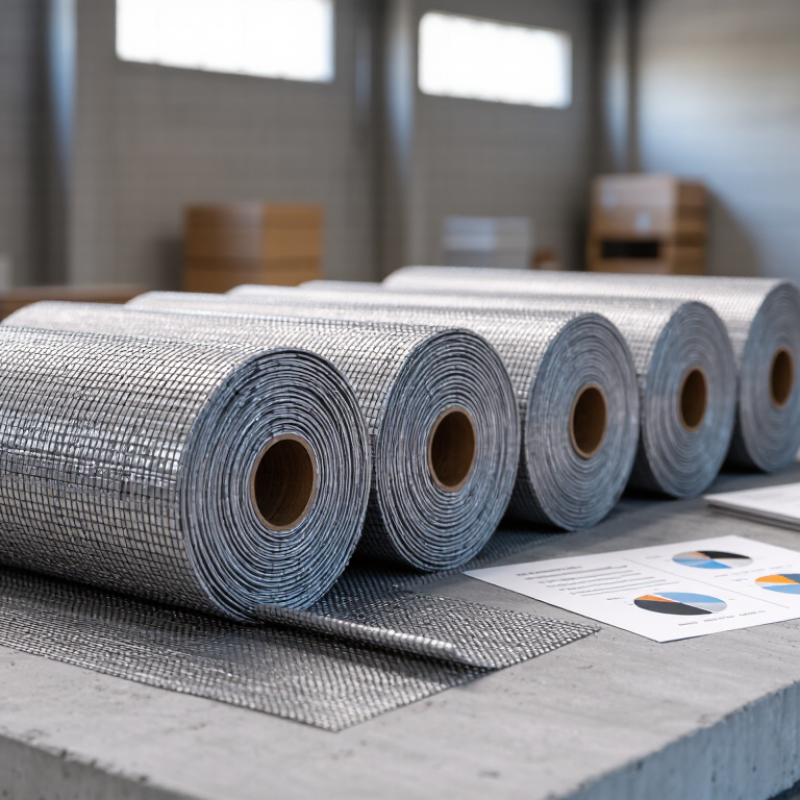
Alkali-resistant fiberglass mesh is a woven grid made from glass fibers designed to reinforce cement-based finishes. Fresh mortar is highly alkaline, so ordinary glass can gradually lose strength as the cement paste attacks its fibers. AR glass uses zirconia in its composition to improve resistance.
ASTM C1666/C1666M specifies a minimum of 16% zirconia for alkali-resistant glass fibers.
That chemistry matters. It slows degradation, but does not make the mesh immune to damage or poor installation.
The mesh also relies on a polymer coating to protect fiber bundles and help the grid hold together during handling and embedding. In a plaster layer, the openings let mortar pass through and surround the strands, helping distribute small stresses and limit crack growth. A torn edge or exposed bundle can become a weak point. Details matter.
The ASTM threshold applies to AR glass fibers, not automatically to every finished mesh product; buyers should check test reports for the mesh itself, including retained strength after alkali exposure. Look for clear information on coating, mesh weight, and opening size too. A dense, heavy grid may seem reassuring, but it can be harder to embed fully in a thin coat. That trade-off deserves a closer look.
Fiberglass mesh begins as silica-rich glass melted at high temperatures and drawn into fine, continuous filaments. The filaments are grouped into yarns, then woven into a grid with consistent openings. For alkali-resistant mesh, the glass composition commonly includes zirconia to improve resistance to cement’s alkaline environment. A protective coating is then applied to help bind the yarns and reduce damage during handling and installation.
Small defects count. Durability depends on more than the label. Filament quality, yarn thickness, weave consistency, coating coverage, and the amount of zirconia all matter. In practice, a mesh with broken strands or uneven coating may perform poorly, even if its specifications look impressive. Once embedded, it also needs enough cement cover and careful placement; folds or exposed edges can create weak spots. Moisture, temperature changes, and prolonged exposure before installation may further affect performance. Still, a laboratory strength value is not the same as years on a wall. Buyers should compare test methods and ask whether results reflect the intended cement-based application. I would not judge a roll by appearance alone. Check its technical data, inspect a sample, and confirm that the mesh feels evenly coated without brittle or loose yarns.
| Buying or Production Factor | What It Means | Typical Details or Checks | Effect on Durability |
|---|---|---|---|
| Glass-fiber composition | Alkali-resistant mesh is made from glass fibers formulated to better withstand the alkaline environment of cement-based materials. Zirconia-containing glass is commonly used. | Check the declared glass composition and applicable product specification. Zirconia content varies by product; do not treat one percentage as a universal pass/fail threshold. | Suitable glass composition helps limit strength loss during contact with cementitious materials over time. |
| Fiber formation and yarn preparation | Molten glass is drawn into fine filaments. Filaments are gathered into strands or yarns, which are then prepared for weaving or another mesh-forming process. | Uniform yarns and consistent filament distribution help create a more even mesh. Buyers can review production controls and product data for consistency between rolls. | Uneven or damaged yarns can create weak areas that are more likely to break during handling or use. |
| Mesh forming | Yarns are commonly woven into an open grid, although mesh construction can vary. The resulting openings allow the cement-based material to pass through and surround the reinforcement. | Common openings are in the approximate 4–6 mm range, but dimensions differ by application and product. Confirm the stated opening size and roll width. | Consistent openings support even embedding. The correct mesh geometry depends on the installation system and its technical requirements. |
| Polymer coating | Many products receive a polymer coating, often based on an alkali-resistant formulation, to bind yarns, improve handling, and help protect the fibers. | Ask for coating type, coating consistency, and relevant test information. Coating chemistry and application quality vary among products. | A suitable, well-applied coating can improve handling and help protect the mesh; it cannot compensate for unsuitable glass composition or poor installation. |
| Area weight | Area weight is the mass of mesh per unit area, usually reported in grams per square metre (g/m²). | Products for plaster and façade reinforcement are available at different weights, commonly from about 145 g/m² upward. Verify the declared value and its tolerance for the intended system. | Weight alone does not establish strength or service life. Yarn construction, coating, glass composition, and test results also matter. |
| Tensile strength | Tensile strength measures the force the mesh can withstand when pulled. Results may be reported in the warp and weft directions. | Compare values only when the test method, specimen direction, conditioning, and units are comparable. For cement-based systems, relevant methods may include ASTM E2098/E2098M or EN 13496, where applicable. | Higher and more consistent tensile performance can help resist cracking stresses, but the result must be considered together with the system design and installation. |
| Strength retention after alkali exposure | This measures how much tensile strength remains after specimens are exposed to an alkaline conditioning procedure. | Request the original and post-exposure results, the test method, and the reported retention calculation. Test conditions can differ, so compare like with like. | Retention data is more informative about alkali resistance than an unconditioned tensile value alone. |
| Installation and embedding | Mesh is generally embedded in the specified base coat or cementitious layer, with overlaps and placement following the system instructions. | Check required mesh position, overlap, substrate preparation, and layer thickness in the project or system documentation. Keep mesh fully covered as specified. | Poor embedding, insufficient coverage, or incorrect overlaps can leave the reinforcement vulnerable and reduce crack-control performance. |
| Storage and handling | Rolls should be kept clean, dry, and protected from physical damage before installation. | Inspect packaging and rolls for moisture damage, crushed edges, contamination, or broken strands. Follow the supplier’s storage instructions. | Moisture, contamination, and mechanical damage can make installation harder and may compromise local mesh integrity. |
| Buyer’s selection checklist | Choose mesh for the intended application rather than relying on a single headline specification. | Confirm intended use, glass composition, area weight, opening size, tensile results in both directions, alkali-exposure results, test methods, roll dimensions, and compatibility with the specified system. | A mesh supported by comparable test data and matched to the installation system is a more reliable choice than one selected by weight or price alone. |
| Note: Values and construction details vary by application, manufacturer, and regional requirements. Treat typical ranges as general market guidance, and verify current technical data and applicable system specifications before purchase. | |||
For an alkali-resistant fiberglass mesh, start with the project’s exposure and finish system. Cement-based renders create an alkaline environment, so request tensile results before and after alkali conditioning. The European assessment document EAD 040083-00-0404 uses residual tensile strength of 20 N/mm as a performance benchmark for reinforcement mesh in ETICS. Confirm the applicable edition and system requirements. A single number is not a guarantee.
Check the mesh’s tensile strength in both warp and weft directions, its aperture size, and its mass per square metre. These affect load distribution, embedment, and handling on site. ASTM C1666/C1666M covers alkali-resistant glass-fiber yarn; it can help assess the raw material, but it does not certify a finished mesh. Test the finished mesh. Ask for the test method, conditioning details, and results—not just a “high strength” claim. Small print matters.
Match the opening size and mesh weight to the render thickness and substrate movement. A heavy mesh may be harder to embed evenly in a thin coat. A very open mesh can leave weakly reinforced areas. I would also check roll consistency and coating condition; these details are easy to overlook. They do not replace laboratory data, but they can reveal practical problems before installation.
Buyers comparing alkali-resistant fiberglass mesh in 2026 should check test evidence, not rely on a “high strength” label.
The 2024 Global Status Report for Buildings and Construction by UNEP and GlobalABC reports that buildings used 32% of global energy and produced 34% of energy-related CO₂ emissions in 2022.
These figures make durability worth examining, but they do not prove a mesh will last. For AR glass fiber, ASTM C1666/C1666M specifies at least 16% zirconia by mass. Note that this requirement concerns the fiber, not finished-mesh performance.
Request finished-mesh tensile results, including after alkaline conditioning, and check the test method and sample details. EN 13496 provides a method for testing glass-fiber mesh used in external insulation systems.
Compare mesh weight, opening size, roll width, and batch consistency against the project specification. Then calculate delivered cost per square meter, including freight, overlaps, and cutting waste.
Not always. The lowest roll price can mean more waste or less verifiable performance.
Ask for batch traceability and reports matching the actual product. One limitation remains: a laboratory result cannot fully predict installation quality or site exposure. Verify that the stated compliance route fits the intended wall system and destination market.
Before buying alkali-resistant fiberglass mesh, verify that the supplier can explain its specifications and testing. Ask for a current technical data sheet and a batch-specific test report. Check whether the stated alkali-resistance results include the test method, exposure conditions, and strength retention after testing. Compare these details with your project requirements, not just a product description. A polished document helps, but it is not proof.
Tips: Check mesh opening size, roll width, and mass per square meter against the order. Inspect several places on a sample roll. Look for loose strands, uneven coating, frayed edges, or brittle patches. Gently pull a few strands; inconsistent coating may show up as powdering or flaking. Confirm the rolls arrive dry and wrapped against dust and moisture.
Where possible, request a sample from the same production batch you plan to purchase. Compare its weave and coating with the approved sample before accepting a large shipment. Ask how the supplier traces batches and handles quality complaints. Keep photos and inspection notes. Even careful checks leave some uncertainty, and a quick visual review cannot confirm long-term performance. I would not rely on appearance alone.
Compare the nominal areal weights shown below as indicative market examples. They are not universal standards or proof of alkali resistance.
How to verify before purchase: Confirm the mesh’s nominal weight, aperture size, and tensile strength in both directions against the project specification. Request a test report showing tensile performance after alkali exposure; weight alone does not establish alkali resistance. Check that the report identifies the tested product and method, and inspect a sample for uniform openings, intact coating, and frayed or damaged edges.
The weights are illustrative examples commonly encountered in product specifications; actual offerings and requirements vary. Ask suppliers for documented, product-specific values.