Choosing the right Spc Panels is not simply a matter of comparing prices. Global buyers must examine structure, surface performance, installation design, and supplier reliability. A panel may look attractive under showroom lighting but perform poorly in humid warehouses, busy hotels, or homes with uneven subfloors. Small details matter.
According to flooring materials specialist Daniel Foster, “The best SPC panel is not the thickest one; it is the one that matches the building, climate, and installation conditions.” This practical view guides our evaluation. We compare stone-plastic composite density, wear-layer thickness, dimensional stability, locking accuracy, acoustic backing, and surface texture. We also consider formal test documentation, responsible manufacturing, and after-sales support. These factors help buyers reduce avoidable claims and replacement costs.
Real projects rarely follow catalog promises. A rigid core can resist moisture, yet poor installation may create movement or noise. A premium decorative layer may impress customers, but weak edge protection can damage quickly during transport. No ranking can fit every country or project. That limitation deserves attention.
This guide reviews ten leading SPC Panels for international buyers. The selection focuses on measurable performance, practical availability, and supplier consistency. We also consider residential, commercial, and hospitality applications. Samples should still be tested locally. Temperature changes, subfloor quality, cleaning routines, and installer skill can alter results. The strongest choice is often less glamorous. It is the panel that remains stable, supported, and economical after installation.
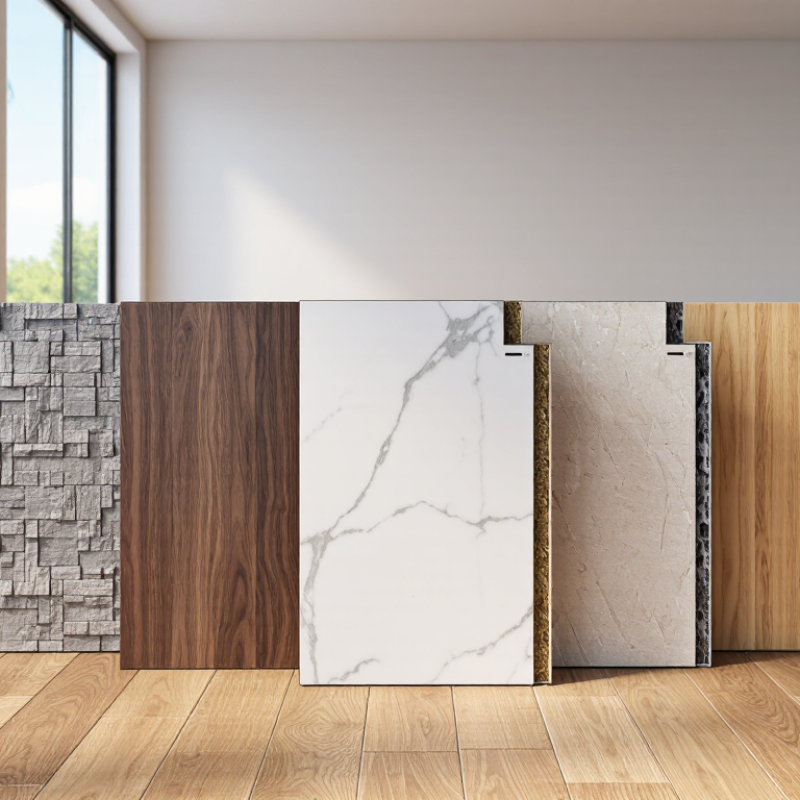
SPC panels are rigid flooring or wall-covering boards made from a stone-plastic composite core. The core usually combines calcium carbonate, polymer resin, and stabilizers. Unlike ordinary plastic boards, this mineral-rich structure feels denser and resists everyday dents. Most panels also include a UV-protective coating, decorative film, transparent wear layer, and backing layer. Each layer has a practical role.
The wear layer protects printed patterns from foot traffic, chair wheels, and frequent cleaning. The core supports dimensional stability when temperature and humidity change. A backing layer can reduce minor floor irregularities and improve underfoot comfort. Water is the test. In bathrooms, kitchens, and humid coastal projects, sealed joints and accurate edge treatment matter as much as the panel itself. A waterproof core does not guarantee a waterproof installation.
Global buyers should review abrasion results, slip resistance, fire classification, formaldehyde or VOC reports, and dimensional-change data. Test methods must be identified clearly, because impressive numbers can lose meaning without a recognized standard. Thickness, locking accuracy, panel flatness, and carton protection also affect real performance. In warehouse inspections, damaged corners often reveal weak packaging rather than weak material. Details matter.
Some product claims still sound too optimistic. SPC can resist moisture, but it cannot correct an uneven subfloor or careless installation. I would compare samples after temperature cycling, not only under showroom lights. A slightly duller surface may prove more practical than a glossy finish that scratches quickly. Performance depends on structure, testing, installation, and use.
| Rank | SPC Panel Configuration | Recommended Application | Overall Thickness | Wear Layer | Core Structure | Water Resistance | Typical Fire Classification | Surface Performance | Main Buying Advantage |
|---|---|---|---|---|---|---|---|---|---|
| 1 | Heavy-Duty Commercial SPC Panel | Retail stores, offices, hotels, and busy public interiors | 5.0–6.5 mm | 0.5–0.7 mm | Rigid PVC and limestone composite | Excellent for surface spills | Often Bfl-s1 or equivalent when tested | High abrasion and stain resistance | Best balance of durability, appearance, and lifecycle cost for high-traffic projects |
| 2 | Stone-Look SPC Panel with Embossed Surface | Bathrooms, kitchens, entrance areas, and hospitality spaces | 4.0–6.0 mm | 0.3–0.5 mm | Rigid mineral-filled PVC core | Water-resistant panel body | Depends on the tested assembly | Textured surface improves visual realism and traction | Combines stone aesthetics with easier installation and lower weight than natural stone |
| 3 | High-Wear Wood-Effect SPC Panel | Living rooms, bedrooms, corridors, and residential developments | 4.0–6.0 mm | 0.3–0.5 mm | PVC and calcium-carbonate composite | Suitable for normal household moisture | Must be verified by product test report | UV-cured protective finish; good scratch resistance | Provides wood appearance without the moisture sensitivity of solid timber flooring |
| 4 | SPC Panel with Attached Acoustic Underlay | Apartments, upper-floor rooms, offices, and renovation projects | 5.0–7.0 mm | 0.3–0.5 mm | Rigid SPC core plus IXPE or EVA underlay | Water-resistant core; joints require correct installation | Assembly-specific | Improves impact sound and walking comfort | Reduces separate underlay purchasing and can simplify installation planning |
| 5 | Click-Lock SPC Panel | Fast residential renovation and floating-floor installation | 4.0–6.0 mm | 0.3–0.5 mm | Rigid PVC-mineral composite with milled locking profile | Water-resistant when joints are properly fitted | Depends on construction and certification | Stable joints and good dimensional control | Supports glue-free installation and reduces labor time on suitable subfloors |
| 6 | Large-Format SPC Panel | Open-plan interiors, feature walls, retail spaces, and large rooms | 5.0–8.0 mm | 0.3–0.5 mm | Reinforced rigid SPC core | Water-resistant panel body | Requires project-specific testing | Fewer visible joints; careful subfloor preparation required | Creates a clean visual effect with fewer seams, but requires controlled handling and installation |
| 7 | Low-VOC SPC Panel | Schools, healthcare interiors, offices, and environmentally focused projects | 4.0–6.0 mm | 0.3–0.5 mm | Phthalate-controlled PVC and mineral composite | Water-resistant core | Certification-dependent | Smooth, cleanable surface with low-emission documentation | Useful where indoor-air-quality declarations and chemical compliance are procurement priorities |
| 8 | Slip-Resistant Textured SPC Panel | Entrances, kitchens, utility areas, and light commercial facilities | 4.0–6.0 mm | 0.3–0.5 mm | Rigid SPC core with embossed wear layer | Water-resistant; not a substitute for waterproof detailing | Verify slip and fire results for the final product | Textured finish can improve traction under suitable conditions | Offers a practical surface for areas exposed to occasional moisture and foot traffic |
| 9 | Underfloor-Heating-Compatible SPC Panel | Residential and commercial rooms with hydronic or approved electric heating | 4.0–6.0 mm | 0.3–0.5 mm | Dimensionally stable rigid SPC core | Water-resistant panel body | Product and assembly-specific | Efficient heat transfer when installed within temperature limits | Suitable for radiant-heating projects when manufacturer temperature and installation requirements are followed |
| 10 | Recyclable-Content SPC Panel | Green-building projects, fit-outs, and sustainability-led procurement | 4.0–6.0 mm | 0.3–0.5 mm | PVC and mineral composite with declared recycled content | Water-resistant core | Certification-dependent | Performance should be checked against the technical datasheet | Supports material-transparency goals when recycled content and environmental documentation are verified |
Note: Performance ranges are typical market specifications for SPC panels. Actual results depend on formulation, panel construction, installation method, substrate condition, and the applicable test standard. Fire, slip, acoustic, VOC, and recycled-content claims should be confirmed through current technical datasheets and third-party test reports.
